Turtle the Chimney “Sweep”

On Monday as I was leaving the office I found, at the bottom of the steps outside our back door, a mother and her teenage daughter mulling over what to do about an injured bird. As our steps lead almost directly to the street, the bird had possibly been hit by a car. It was stunned with one wing oddly askew like it might be broken. I stopped to assess the damage. It was as if we all knew, the mother, the daughter, me and maybe even the bird that I was the one taking it home.

The mother and daughter wouldn’t know this but I had once successfully raised a baby crow who lived voluntarily in our trees for quite a while after it fledged. I could come outside and yell its name and down it flew to land on my arm for a snack. After I thought it was grown and gone it twice returned injured for a safe place to recover. But that was a baby I’d once fed mashed up worms. It remembered it’s mama Crow. Crows have long memories. This bird, which I first thought was a swallow and later proved to be a chimney swift, hadn’t intentionally sought me out…or had it. Injured animals seem to gravitate toward me. I used to take evening walks to the local courthouse to watch the swifts come in. We called them “sweeps”. My work office is less than one block from that same courthouse. The bird had been injured and landed in the path I take every day. Unbeknownst to me a co-worker had seen it four hours earlier and had decided to leave it but check on it later. Then, the mother/daughter duo worried over it but had no intentions of touching or moving it. I am no stranger to animal rescue. I immediately picked it up. Because of Covid I still had plastic gloves readily available. Thanks to the Beverly Hillbillies there is probably a whole slew of women my age who grew up with the nickname Ellie May for their propensity to capture injured animals and try to nurse them back to health. That’s what Mom called me but I was rarely successful. Nature is a great teacher.

It was a hard lesson to learn but it’s often better to let nature take its course…unless I know there is something I can do. I am quicker to recognize impending death these days. But I still can’t leave the dying to die alone. In this case, my instinct to take the bird might have also been driven by my attempt to relieve the mother’s guilt for disappointing a brooding teenage daughter. I could tell they both needed to think they had done all they could. I could give them that. I took the bird because that’s what I do. I couldn’t let it lay in the gravel and grass until a neighborhood cat decided to make it a toy, or the sun dehydrated it. I thought at the very least, I’d give its death some dignity. It wouldn’t be the first time I’d provided this service. Death Doula to people and animals. Even as I placed it in a cardboard box, I dreaded telling my boyfriend/housemate about our new roomy. He wasn’t around for my dog rescue days so he may not be fully aware of my proclivities to drag in injured animals.

First, I took it to the same veterinarian who helped me with dog rescue to see if its wing was indeed broken. “Looks like it is fractured,” she confirmed. She did not set bird wings but gave me the name of another veterinarian who treated birds. Selfishly I wondered what it might cost and if I was willing to bear that cost. Domestic pets, it turns out, are the only birds veterinarians treat. I called three vets who all said to call wildlife rescue. The only wildlife rescue I could find informed me their Kentucky affiliates had no permit for songbirds which meant the swift and I were on our own. As I write this, it occurs to me, my daughter is attending the latest Taylor Swift Album release in a movie theater. She is decidedly a “swiftie”. I have never listened to Taylor Swift’s music but this little bird has turned me into a “swiftie” as well. Its slim cigar-like torso and pointed wings, the gray top feathers melting into a snowy underside and the sweet way it turned its head to look directly at me when I held it in front of my face or slowly closed its eyes when I stroked its back, made me fall in love. Its beak was as delicate and tiny and black as the tip of a cat’s toenails, but not curved. Looking straight on, its eyes and short bill resembled the face of a turtle, so that’s what I called it. Turtle. It should be said that both sexes look alike in this species and I have no way of knowing whether Turtle was male or female. I deemed her female for no good reason at all.

I hate that we rely on google for so much of our information these days but it is a wealth of knowledge. I did read in my old-fashioned bird books as much as I could about the species, but they don’t tell what to do if you find one with a broken wing. Anyway, google said to keep it still and in a dark place to prevent further injury and then immediately take it to wildlife rescue. Immediately. So much for that advice. I did start it out in a small cardboard box with a makeshift nest of dried grass. The way it climbed up and positioned itself on the side of the box made me research further and realize it was a chimney swift. Whenever I picked it up, its talons clung to my finger like a baby’s first instinct to grasp, another tip that it was a swift. Turns out chimney swifts don’t perch on branches like other birds. They fly for hours or even days at a time, taking their food on the wing. They are aerial acrobats, almost always moving. Most of their diet consists of flying insects so they are extremely beneficial to humans in that way, cleaning up mosquitos and other pests. When they do land for the evening or to make a nest, they cling to the inside of a hollow tree…or a chimney or other tunnel-like structure. Their clinging feet are necessary to adhere to vertical, sometimes slick, surfaces. I anthropomorphized this grasping behavior as if the bird were holding onto me for its very life. That kind of oxytocin release reminded me of all the dog rescue I engaged in during my empty nest years.

Hundreds of dogs I took home from the shelter, bathed and housed. (All dogs come home from the shelter with the same foul odor.) It only took the first bath after leaving the shelter for a dog to follow me faithfully and make me their person. I knew what I was doing while I was doing it—avoiding the pain of my daughter’s impending exit, the truth of my dysfunctional marriage—but I ran into all kinds of rescue folk over the years who were unaware of the lonely hole they were desperately trying to fill. It’s easy to believe an animal loves you when you’ve intervened on their behalf. For the most part, I kept my head about me. The veterinarians I worked with liked my ability to be realistic. Once I knew a dog’s personality, I ran a match-making service with local families to place it in a forever home. I became addicted to learning each personality and it’s true the feel-good sensation of unconditional love is immeasurable. Rescue work is rewarding, but dirty and filled with harsh realities.

I was right about my boyfriend’s response. Gregg was mostly concerned about diseases and insisted I disinfect every place I’d even set the box. I explained that the bird was in a small box which was inside a bigger box so there were two layers between it and any surface. He didn’t buy it. I googled again to find that chimney swifts aren’t known for carrying diseases and are no threat to humans. Sometimes their nests attract mites but I had no nest. Histoplasmosis is a fungus that can grow in bird poop once it has composted but it doesn’t exist in the poop itself as it comes from the bird. I hoped this might waylay Gregg’s fears but I doubted he’d be any happier. He insisted I leave the bird and its box outside.

I wondered how I was going to feed “Turtle”.  They prefer to catch insects in the air but that was not likely from inside a box. Although I did catch a couple of spiders and a fly for her. She was either not impressed or still in shock from the jolt that upended her carefree existence. The book said when insects were scarce swifts would eat seeds or berries so I placed both in a shallow dish alongside a saucer of water. I knew not to force feed with a dropper for fear of setting up pneumonia but I did offer a droplet near her mouth and it opened for two swallows of water.  

After the first night, I thought the tiny bird needed some daylight to inspire its recovery. I didn’t have a bird cage but I exchanged its dark box for a small cat carrier. I attached hardware cloth on the door’s grid to prevent escape or the patient’s cock-eyed wing from getting stuck through the openings. The new space brought new movement. That screened door became her favorite roosting spot since it was easy to hold onto. I still couldn’t tell if she was eating but the food got dispersed as she moved about the cage so at least she knew it was there. Gregg knew I was concerned and joked that I could tie its feet to a string and swing it in the air to catch insects. He thinks he’s funny. But then he did have an interesting idea of putting a piece of fruit in the cage to attract insects, which I tried.

I didn’t have any real expectation that the bird would live. I thought at most it wouldn’t die by predator. But as one day turned to two and then three with more activity each day, I started to think of possibilities. I decided I’d give it a couple more days in the cat carrier and graduate it to a dog crate. I have a large one left from my humane society days because with me, you never know. I would create a chimney in one corner so it could roost properly and if I saw it gliding down from there, even for two wing flutters, I would find a safe place to open the cage and see if it could take flight. Then, I worried that it would live but not fly. Was I prepared for long-term care? What kind of life would it be to go from aerial freedom to living in a cage? Neither of us wanted that. I envisioned building a greenhouse, something I’d been wanting anyway, so it could have some semblance of an outdoor life. It was curious to me how many images google had of chimney swifts sitting in the palm of someone’s hand. I had taken that picture myself. Most bird pictures aren’t featured in someone’s hand. Do people make pets of them? I read that some swifts have been known to live as long as 12 years in the right conditions, yet the average lifespan is about two years. I had no idea how old this bird was. She looked so young and delicate to me yet she was the size of a full grown swift.

Then, on Thursday night, she died. It had been her most active morning and I’d seen her climbing the wire door in the middle of the day but by nightfall, she lay face down on the bottom of the cage. She could have starved but she pooped every day so I thought not. Maybe her body couldn’t take the shock. My guess after the fact is that she had an infection which I had not known to treat. I know she would have died anyway, without my intervention. Still, I wish I could have done better by her. I really don’t know how I would have administered antibiotics but I will think about it next time…because…there will be a next time.

 I am grateful to Turtle for bringing me a whole new awareness and appreciation for chimney swifts. They are amazing creatures with a soft heart and a gentle soul. I don’t know if I made what was left of her life better or worse, but I know this: Death is a sacred act. I have witnessed it many times, with humans and with animals. It is sad to say goodbye, but it is an honor and a privilege to hold space in those last holy moments. At least she didn’t die alone. Fly away, little Turtle, fly away.  
Alchemy

Alchemy: a power or process that changes or transforms something in a mysterious or impressive way.

I went to dinner in Lexington with some women. Friends, and friends of friends. Three of them had birthdays in the same month so not only was there reason to celebrate, after dinner we were attending a reading by another friend who was celebrating the release of her latest book. A night out for the ladies.

Since we had gathered primarily for the literary arts, the dinner conversation began with literature. Who recently read what, which books are must reads, what we’re currently writing, and morphed into general story telling since most of us were writers of one form or another. One person’s story reminds someone else of a similar story, reminds another, and so it goes. In this instance, we traveled the world going from Chicago to Milan to New York and all the way back to Kentucky, where we all currently live. One theme that emerged was housing. From tiny squeeze-ins to expansive high-rise sublets to starter homes, the ladies spoke of lucky breaks, exigent circumstances and turning bad situations into good. I saw a theme emerging.

“Alchemy,” I said.

“What’s alchemy?” my friend asked. I explained poorly that it was a term referring to the medieval attempt to turn base metals into gold. But that today it also meant just what she had been saying, how she’d turned a bad situation into a good one.”

Then, “Martha’s” Kentucky story of purchasing a farmhouse without prior knowledge of the den of snakes who had taken up residence beneath the front stoop drew gasps from everyone.

            “I’d have to back out of the sale,” one said.

            “Or put it right back on the market,” another chimed in. “You didn’t stay there, did you? Is that where you live now?”

The fear of snakes always sparks eeks and cringes followed by other close encounter stories. I’d venture to guess we all have snake stories. These ladies all did. The fear of the serpent is likely the most common phobia. We love to hate these creatures.  

I, too, am no fan and prefer not to get personal with a snake.  I thought about reminding us all that snake symbolism was originally that of the divine feminine and that maybe we had been conditioned to fear snakes based on the patriarchal need to control the innate power of women. According to Ted Andrews’ book Animal Speak, seeing a snake denotes resurrection, renewal, rebirth (shedding of one’s skin to become anew). In dreams, simply encountering the snake is thought to be the subconscious awareness of a pending new cycle of life. Being overly afraid of the snake symbolizes fear of the changes necessary for internal growth. Getting bit might symbolize the level of resistance or blocks you’re throwing into your own path. I’ve had plenty of these dreams throughout my spiritual awakening journey as well as in person sightings. An explanation like this might be interesting, but it rarely does much to allay a well-honed fear of snakes. Thinking of the power of transformation, I juxtaposed one of my own snake stories instead.  

I am the third generation of my family to inhabit the family farm, in a house that was built in 1901. Dad refurbished the house, mid-seventies. Insulation, Drywall, paneling, popcorn painted ceilings and area rugs turned the place around, even before electricity or plumbing was added. Instead, fireplaces, a Warm Morning stove, outdoor toilet and a rain barrel became our every summer adventure, heading back to a small abode with a thermostat and a real bathtub during the school year. We merrily frolicked at the river’s edge, raised cattle, pigs and chickens, the occasional mule, helped Dad with tobacco, hay, planting and harvesting vegetables, hunted arrowheads, shot BBguns, picked blackberries and maintained a healthy awareness of snakes like we lived in the 19th century. In his head, my father sort of did. I was having the time of my life. Today, I am grateful for this character-building years-long sojourn into the past. My parents installed plumbing and a few other upgrades and moved into the farmhouse after all of us children were grown, around 1991. 

In 2012, due to Mom’s cancer and other circumstances, my father bought a house closer to town and nearer to doctors and the hospital. The farm is isolated with sometimes inaccessible country roads. Since I was freshly divorced, he convinced me to take up residency on the farm so that the empty house would not get vandalized or become a drug den.

In the seventies, Dad didn’t believe in the future of electricity or otherwise could not envision the number of useless appliances the next generation would find not only convenient but necessary. He felt ahead of his time including two whole outlets per room. Re-learning how to live in an old house whose electricity has not been modernized to meet today’s standards and whose prior inhabitants had learned how to “make things work” without actually having them repaired, included several “combinations” of actions I needed to learn to keep the house running smoothly. Namely, deciphering the tangled web of which outlets in how many rooms, both upstairs and down, whose wiring led to the same 15-amp fuse. I should have bought stock in Buse fuses for the number of boxes I purchased and went through in those early months, grateful they still existed.

Another thing he made sure to tell me was about the relationship he had formed with a huge black rat snake that lived in the shed out back. As I’ve indicated, snakes aren’t even my favorite subject, but out of reverence to my father, I listened to his tutorial.

            “You know I store feed in that building, for the cattle. Mice get in it and make a big mess. That big snake keeps the mice and rat population down so I like him being in there. He’s not poisonous and he never bothers me. When I go into the shed to retrieve the lawn mower I talk to him, warn him I’m coming in. He may be hanging from a rafter or laying on the ground someplace. I pull the riding mower out and start it up. When he hears the engine, he comes out and makes his way down toward the pond. I guess he’s getting a drink. I don’t see him again until after I’ve finished cutting grass. Later in the evening, when it’s quiet, I can sometimes see him returning to the building. We’ve been doing this for years. We made a deal.”

            “Okay,” I tell him, “I can live with that.” Even though secretly I thought, okay then, I’m not going in that shed, which turned out to be impossible. So, I did indeed follow in my father’s footsteps and tried my hand at snake whispering, which might or might not sound more like clanging and banging and yelling warnings rather than actual whispers. I named the snake, Earl.

Dad cut more grass than the immediate area around the house. He had cleared and tamed almost an acre of land, to keep the snakes at bay, he’d said, even though he made exception for Earl. He thought it wise to claim territory separate from the wilder fields and fence rows that bordered the woodland’s edge to provide a clear view of encroaching wildlife. He advised me to do the same. But since he took his riding mower with him to the new house and I still only had a push mower, I hired a neighbor to keep my lawn tidy. I told him the snake story and asked if he could please respect my father’s wishes and look out for Earl. “It’s been there for years,” I tell him. “It doesn’t want to harm anyone.”

Vernon was on the lookout for Earl, no doubt. His first encounter with Dad’s rat snake shocked them both. He entered the shed looking for a weed eater. The lanky sentry hung from a rafter at eye level as he entered, probably wondering who the hell this guy thinks he is entering Herbert Crow’s field mouse buffet. After that, unbeknownst to me, Vernon began strapping on a sidearm before arriving to mow the grass.

After a month or two of cutting the grass with no further incidents I thought all was well. However, one day, Vernon gave in to his own fears and ignored my sentiment about the friendly cohabitant of my abode. He knocked on my door, and using a hoe to extend his reach and not actually touch the old guy, held out his conquered prey to me the way my dogs string out a dead rabbit on my doorstep…as a gift.

            “That’s Earl,” I say, confused.

            “Don’t worry, I got him,” Vernon said. “I hate me a snake. That’s why I carry this.” He proudly pointed to his waist band where he’d holstered the offending weapon. The story he told was just as my father had described, the snake heard the mower and came out of the building to head down to the pond, minding his own business. Only Vernon didn’t care where he was going. Seeing the snake, he chased it down with his lawn tractor, close enough to get a good shot with his pistol because he sure as hell wasn’t going to get off that mower and possibly get bit. He also wasn’t going to let it out of his sight for fear of where it might go…and…he didn’t want to miss. Poor Earl had made it all the way to the fence row, about to cross the threshold to safety before he felt the blow. Vernon was proud.

My father had warned me about the snake we’d named Earl. But we both failed to warn Earl about the viper named Vernon.

            “Oh, that’s so sad,” said the lady who would have instantly sold Martha’s den-of-snakes’ house.

“I can’t believe he did that!” said another. “Did you let him keep mowing your lawn after that?”

“Do you hear how you have all changed your attitudes from loathing to compassion and concern for a snake?” I ask, “Now, that’s alchemy.”         

Virtual Nonny

To say 2020 was a challenging year would be an understatement! Many of us were separated from our loved ones across the miles or even across the backyard. Unable to visit in person or give much needed hugs, we adapted to maintaining relationships through a telephone or on a screen. It was disheartening and painful to watch the unmasked continue to act as if there was no pandemic while people were dying in droves. Those who kept traveling, visiting, gathering, endangering and prolonging this situation for the rest of us was maddening. For me, the struggle has been curtailing my harsh judgment, disdain and loss of respect for people I’ve known and loved for years.

My daughter and her family live 2500 miles away. I was there in March, 2020 just before things shut down. For a long while, we didn’t know when it would feel safe to travel again. I became quite neurotic about keeping myself safe—just in case—one of them got sick and needed me.

Like other families balancing work/family life, having even one child home 24/7 and adding a virtual school element was an added struggle. Simple tasks such as having an adult conversation without probing ears, or making a grocery list became a chore. Not to mention keeping him busy during work hours or zoom meetings.

I have never touted my technological skills but thanks to my savvy four-year-old grandson helping an old lady out, I became a pretty good virtual grandma. Nonny, to be exact. My daughter suggested I switch out my Android phone for an IPhone so we could more easily use the FaceTime App. We found out I could entertain my grandson over FaceTime while his parents took a breath. Sometimes, we stayed on the phone for three or four hours at a time, the only pandemic babysitter they had.

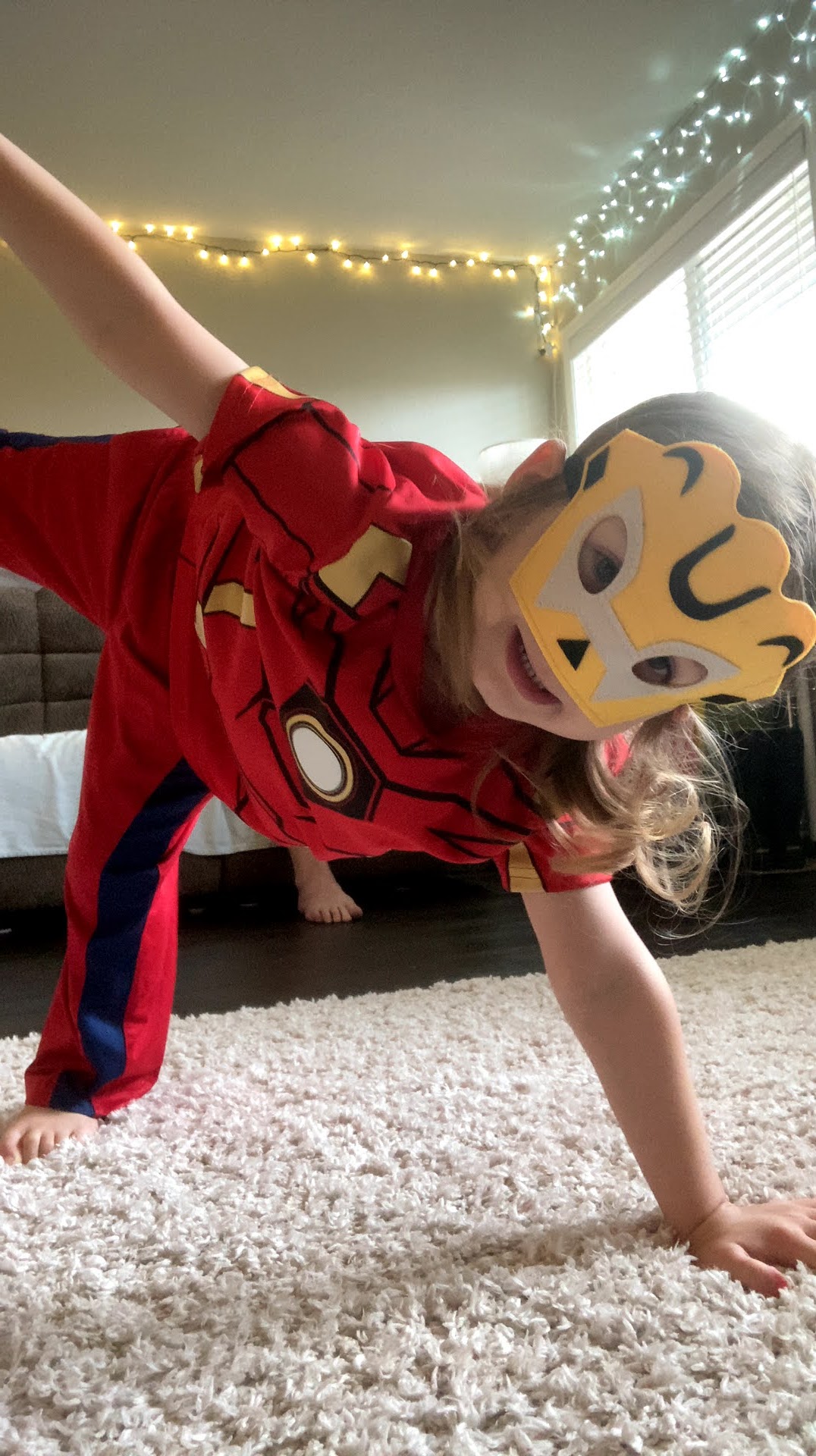
I loved seeing the excitement in his eyes when I’d learned the names of his Rescue Bot toys. He taught me about transformers, superheroes, construction equipment and more. The phone with my face on the screen became a stand-in for me. He placed “me” on the back of a toy racecar and squealed, “Hold on, Nonny!” Virtually, I zoomed around his home (seeing only the ceiling go by), went with him into hiding places, cuddled on the couch or simply sat on a shelf and watched while he transformed from vehicle mode to robot. I’ve even been allowed to accompany him in time out. In his room, under his bed or under a blanket tent, he shared with me his feelings (very self-aware), something I may not have gotten in person—especially when he was mad at the adults in his life. On the phone, far away, I became his safe buddy. In some ways, the intimacy that comes with remote communication changes the grandparent dynamic. Sometimes, I’m more playmate than disciplinarian. Yet, I can tell there are certain topics he shields from me that he tells his Mom. My status as grandparent is flexible. I initially tried to use the opportunity for educational flash cards and to play school and read books but typical boring grandma stuff wasn’t going to fly with the boy for long. He needed a playmate who understood his obsession with Bumble Bee the Transformer.

By the time he was five, he could spell and do complicated math. For a while, rather than FaceTime, we texted on his mother’s phone. He could put together complete sentences. He liked to surprise me by choosing the most popular intuitive word choice that popped up in the bar and see what sentences we could make. I responded by doing the same with my phone. In this way, I also learned about my daughter’s conversations with her friends, which was an interesting perk. He learned how to send me filtered pictures that looked like cartoons. I asked him how to do it and he texted me step by step directions how to use my iPhone to use emoji’s, photo filters and more. We started taking regular pictures around the house and then adding artistic drawings on them. For instance, a Santa Clause hat on a picture of my cat. Or, his drawing a white beard on his own face. His directions were superb, not like an impatient teenager who just whizzes through the steps for you without teaching anything. This kid is a natural born teacher.

The first time I masked up for a visit after vaccines, he kept reaching out to touch my face, “I can’t believe you’re really here!” he said.

He’s seven now, but still thousands of miles away. We still FaceTime. He calls almost daily. If even a few days go by without contact, I witness great strides in his intelligence and understanding. By virtue of his level of sophistication our games have become more elaborate.

He tells me he is “the director, the producer, the stage hand and one of the actors. Nonny, you are all the other actors,” he says with a laugh. And, director, he is. He has scripts in his head with elaborate costuming detail that we imagine. It is important to him that I have in my head exactly what he sees in his mind’s eye. The colors of a dragon, its eye color, wing span, special powers. The way his Werewolf character still has wolf ears and sometimes a tail when she is in human mode but also what color and how long her hair is and what she wears. Whether I am a black panther that can turn into a human or maybe a hyena or even a hamster, there is a script. If I ad-lib too much he cuts the scene, instructs me on his vision and then says “Action”.  We have named this game “Schizophrenic” because of all the personalities I have to take on. He snickers every time he tells me my next role. It’s part of his fun to shock me and more fun for him if I act shocked. I have been any number of animals, teachers, friends, transformers, mythical creatures. Whatever his imagination (or the latest video game, movie or television show) introduces, I become.

My favorite game is YouTube or Podcast. In the first, my boy demonstrates a skill he has learned and I am his audience. His introduction, ability to break down the steps, and his warnings what “not to try at home” are hilarious and spot on. In Podcast, he is the star of the show and I am the guest. We go back and forth with questions like an interview. With this game, even though we are playing characters, I learn how is day has been, the highlight of his week, who his new friend is, what he has been watching. It’s like a real conversation for me but because “talking is boring for kids” podcast makes it a game he will play.

“Google Black Princess Dragon,” he says. Or, “Look up images for the Tails character on the Sonic Movie”. I have done my research, let me tell you. This Nonny, in my own adult home with no children around may be caught watching “Sonic”, or “How to Train Your Dragon” or “Transformers”.  “Have you seen Spongebob?” he asks. “In this scene, your house looks like Sandy’s.”

In real life, I live in my family’s third generation farmhouse. I’ve found myself walking in my parents (and grandparents’) footsteps on many occasions. This year, my garden would make my father proud. Every time I can tomatoes or freeze corn I think of my mom. In some ways, I believed my grand-parenting days would be more traditional, more like theirs, more in person and hands on, passing on my love for the earth, gardening, flowers and nature walks. But children don’t stay near their birthplaces like they did in older generations. Loads of grandparents live long distances from their children and grandchildren. Though I think there is value in family groupings, these days, that way of life seems obsolete. Sometimes I lament that I don’t have the weekend sleepovers, the after school visits, but I do have some things other grandparents don’t. Our relationship is far from traditional but very special, even across the miles.

Adjusting my expectations, allowing my grandson’s natural understanding of technology to pull me along, maybe I’m not as obsolete as I feel. I resist technology on many fronts, but if it weren’t for FaceTime, I would be missing so much of his childhood. We would have figured this out sooner or later, but it seems the pandemic pushed us to learn how to keep in touch in this new way. A way that, to his generation, comes naturally. When swapping grandchild stories with my friends, though our hands on experiences are much different, our exhaustion levels are about the same. It’s hard work to be a panther who turns into a boy with a hyena for a brother, and school friends who are snakes, hamsters, dragons or werewolves, without eating one another! I don’t know many grandmothers who know this.

I have always been one to look for silver linings. There is a word spreading across social media for when you find a tiny piece of joy in the world. Glimmers. This boy, this brightly shining light, is one of my best glimmers.

A Mountain of Faith

I have always felt that each woman needs at least 7 other women in their lives who will listen, advise, hold them up, light the way. This is the first in a line of essays where I honor the strong women who have provided a light for my path, be it one moment of for years. I met Edna only once, but she made such an impression…

A vision in dark brown cotton from head to toe smiled from across the freshly swept yard. Her homemade dress was buttoned up to the neck and reached all the way down to her ankles.  She wore a brown sweater.  A matching brown bonnet covered her head.  Her boots were supportive of mountain walking.  It was evident that everyone here revered Edna as a matriarch.  She was bombarded with a flood of grandchildren, nieces, nephews and neighbors rushing up to give her a hug.   Once a year, near her birthday, people stop by to pay their respects.  Bearing food and musical instruments, they have come to stay the day.  I accompanied my friend Barb for what she called, “walking up the holler a-ways to a singin.”

I knew the minute I met Edna she was something special. She was surrounded by an energy that was evident to me. I felt it. I don’t read auras, but if I did hers would be bright. After a bit of chit chat with my friend Barb about how she’d been, Edna took my hand. A pool of water formed in her eyes and she said, “I know you by your touch.  Praise Jesus.  I can feel Him in you.”  She didn’t let go of my hand for some time and pulled me around the yard introducing me to her family, being as though I’d never been there before. Her brother Joe, seemingly well known in the bluegrass music crowd, was entertaining a gathering on the porch of a log cabin. She lived out of the far reaches of electricity or indoor plumbing, off the grid you might say, but had all the amenities needed for a strong healthy life.  

She wanted to show me things, like the treadmill her son had made.  A horse walking the treadmill turned a long pole which was attached to the handle of an ice cream freezer.  “You can churn with this or anything,” she said.  “Isn’t it great?”  She was proud of her life and proud of her children. 

“How many children do you have?” I asked.

“Seven. They’re all real smart about this mountain and can do anything it takes to live.  I taught them that. Respect the mountain and it respects you, gives you a good life.”  Then she leaned in, “But, they ain’t had no education.  I wouldn’t let’em go,” she whispered.

“They do have an education, though, about life,” I said.  She smiled.

“You’re right,” Edna said.  “God told me to come up on this mountain and live and raise my kids and He would provide what we needed, so I did.  I take care of His Mountain and He takes care of me. I’m the only one knows how to keep this place clean.” 

She told me of getting married and moving north to Ohio as part of the out migration looking for jobs. “I had no business being up there,” she said.  “It made me sick.”  Her words echoed feelings I’d heard before, being a southern girl and all.  “The doctors said I had cancer,” she continued.  “They gave me three months to live, but God told me to get back to the mountains and I’d be okay.  That was fifty years ago.”  Her faith was unshakable. Being in her presence brought me a sense of peace.

She and her family are squatters on wild mountain property. She says, “You can live on it, but you can’t own it,” and “The less the government knows about you, the better.”  She doesn’t believe in deeds or government assistance. 

“How many grandchildren?” I asked.

“Honey, I think its twenty-two if they ain’t slipped no more in on me since I last counted.  They’re spread all over.  Most of them will be here today, though.  I even have some in-laws coming in from Ohio.  That should be fun.  They don’t know why I like to live up here.  They’re town people. I always like to show’em my fancy outhouse.”

A young man walked up with a big smile on his face and hugged Edna. 

“Hey, Granny, how are you?” he said.  He wore a black AC/DC shirt and tight straight legged black pants, and his dyed blue/black hair hung over part of his face.  His ears were pierced. 

“I guess you heard I fell,” she said.  “I broke a rib, punctured my lung.”  She held her side to show him where it hurt.

“I heard that,” he said.  His arms wrapped around her in a protective and loving hug.  “I hope you learned a lesson from that, wandering around up here all by yourself.”

“Honey, the lesson ain’t for me.  God lets me be a lesson to others.  I prayed real hard for God to get me out of that ditch.  He commenced to healing me and brought me home.  I’m almost as good as new.  The lesson’s for you.  It’s about faith.”  He laughed and kissed her on the cheek then moved on to talk to his cousins.  Edna didn’t judge him or scold him or any of the others.  She accepted them and loved them and they loved her.

“Do you ever leave the holler?” I said.

“Oh, yes, honey, I go up on the mountain and over to the cave, and sometimes I go over to another holler where my girls live.  I travel all over these hills.  I have two or three places in different hollers where I sleep.” It wasn’t exactly what I meant, but I got my answer.

The log cabin her son had built with hand hewn logs was plainly elegant with a full wrap around porch.  It was placed in a wide clearing in the deep woods near the creek bed road we had foot traveled earlier. He had one room dedicated to the food he canned and preserved from his own garden, enough to last all year.  A Lincoln style wood plank fence enclosed pastures of horses; some were being ridden by the grand-children.  A hay wagon in the yard became a table for all the food being brought in by the arm-loads.                         The vivid greens of the grass, trees and hills reminded me of a lush spring though it was near the end of summer. Not the hot browned look of our burned-up city lawns looking for relief. The creek we had followed sang to us as water flowed over rounded rocks. With no unsightly electric wires, cell-phone towers or satellite dishes it was easy to transport ourselves into another century.

My grandparents were dead before I was born, though I experienced summers on the family farm without utilities. Playing at the springhouse, catching rain-water in a barrel and decorating an outdoor toilet made me appreciate what it takes to live. I am grateful I was able to connect to my grandparents’ way of life.   

“So, you don’t live here with your son?”

“No, honey, I have my own place, several places really.”

“Tell me about the cave,” I said.

“There’s a cave with a spring in it.  That’s where we used to do our laundry.  I make a bed in there with a sleeping bag.  Sometimes I stay there two or three days.”

“What do you do there, while you’re waiting on your laundry to dry?” I asked.

“I pray.”  She pointed to an attractive woman, mid-thirties, with long, loose blond curls hanging over her shoulder.  She wore a red blouse and dress pants.  “When that young’un there was little enough to fit in the sleeping bag with me, we both went up there and stayed.  I came out one time and found snow about yay deep.”  She put her hands about twelve inches apart.  “I’m real lucky my kids let me do what I want.”

“How old are you, Edna?” I asked.

“I’ll be seventy-nine, August the ninth.”

“Do they worry about you a lot?”

“Sometimes I have to wait till they’re all gone if I want to climb on the roof or something.  They fuss about that.  They know how to find me, though, if I ain’t home.  I’m usually at the cave.  But that cabin on the mountain is where God wants me most of the time. It’s a place we used to have services.  People from all over these hills came up there to sing and pray.” Edna had a yard full of guests, easily over a hundred, many of whom had transported themselves into her holler by horse or foot so it wasn’t hard to imagine she was telling the truth.  “One time, I was worried about food and God told me he’d provide me all the food I wanted.  Don’t you know, swarms of bees moved into that cabin with me and stayed up in the ceiling between the cardboard and the tin.  I used cardboard you know, like people do to insulate the inside of the cabin.  Some stopped coming up there cause they were scared of the bees but they didn’t bother me none so I left’em alone and before long I had the prettiest honey combs you ever did see.  That honey tasted sweet, like the butter had already been added.  People came then I reckon cause they wanted my honey.” She laughed at the memory. “That’s how God provides for me.”  We meandered around the yard arm in arm looking at the handiwork of God and Edna’s children. The whole scene was like a memory I’d forgotten to have. I wanted to hold it close, study it so it wouldn’t slip away. 

“Do you have any preachers in your family?”  I don’t know why I asked that but she seemed like an incarnation of…well, something. I just wondered what religion she claimed.

“My uncle called himself a Holy Ghost preacher.  Some people call them Holiness. But, I don’t go in for all that.  People didn’t used to care what you called yourself as long as you belonged to God.  I think God don’t care what you are as long as you’re listening to Him.  And, I listen honey, Praise God!”  Tears seemed always just behind her soft eyes as she squeezed my hand.  “God walks beside me all the time, invisible.  Some people can’t see it.  But you see it.  I can tell because He walks with you, too.”

Barb came along and reminded me that I had to be back in town by 2:00 p.m. I had completely forgotten to check my watch.  Somehow it didn’t seem important anymore. I could have stayed all day and night talking to Edna. I realized I must be monopolizing her time with her family so I made a move to leave.  I hugged her and said I’d best be going. I felt so connected to Edna I wanted to be related to her. I wanted to be her.    

“Can I come back and see you some time?”  I said.  “I want to talk to you about signs.”

“Oh yes, honey.  They’s signs and you need to know’em.”  I got the feeling Edna knew things about me that I didn’t know myself, that there was a collective presence here today, in both of us.  “God tells us everything we need to know.  It’s up to us to listen,” Edna said.  “But, don’t wait too long about gettin’ back up here,” she squeezed my hand again, “Hear me?”

“How will I let you know I’m coming?” 

“You call my daughter, “Dee,” she’s the only one with a phone.  She lives out on the road.  She’ll tell you where to find me.”  It was the daughter who’d spent nights with her in the cave when she was little, now obviously a woman of the modern age.

“If you come back up here to see Mama, better plan on staying a couple of days,” Dee said.  “Call me and I’ll tell her you’re coming.”

They had a message system.  An old push-mower, the kind without the motor and with a box attached to the back for tools sits at the bottom of the hill beneath Edna’s cabin.  She puts a note in the toolbox if she needs something and the children put a note in there if they want her to come down to see them or need to get her a message when she’s not home.

The realization that she was truly off the grid was just forming in my mind.  I knew Barb had said she homesteaded her place, and home-schooled her children way before it was a fad, but she truly did live outside the lines.  I learned also that she birthed her children at home and they did not have social security numbers. 

“If I’m not home, I’ll leave red strings tied to the tree limbs so you can follow.  I might be at the cave.”  I have to admit it scared me a little bit, to think about trekking all over this mountain by myself, following red strings to find Edna, though I hoped I had it in me. 

I wanted to imagine I’d finally met my grandmother or maybe even several generations of grandmothers.  I couldn’t get enough of her.  I forgot about my at home to-do lists and expectations and remembered ancestral things I once knew but had let slip away.  I felt a sacred whisper flowing through my veins and I was grateful.

 It took thirty minutes walking a fast clip back to the place we’d abandoned the car and at least another thirty to drive back to town.  I didn’t talk but inhaled as much of Edna as I could. All I could think of was coming back. I wanted to tell everyone about this hidden treasure of times past as if I’d discovered her myself, but at the same time didn’t want anyone spoiling what she had accomplished, as if it were my job to protect her secrets.  Her simple lifestyle relying on intuition and signs to guide her daily decisions comes from being totally in touch with her mountain roots.  Roots I share but skills yet to be honed.

On our way out, people continued to trek back into the holler and Barb explained there would probably be 400 people by the end of the day.  My secret treasure wasn’t a secret.

“Dolly Parton has even been here,” Barb said.  “Edna’s grand-daughter breaks and trains all Dolly’s horses.”

“You’re kidding,” I said.  “I should write a story about her.”

“Everybody’s written about her.  There’s a whole chapter in a textbook at Appalachian State University.”  I felt like I had been spiritually blind and this was a day of vision.     

Edna is a monument, a mountain of faith.  She doesn’t have to leave her holler or travel the earth to become wise or make a difference.  She only has to listen to the earth as it speaks to her. I was only with her for a short while, but she saw me and I saw her and it made a difference. She is not a traveler, she is a destination.   

(This essay was written in 2006. Edna has been gone for several years now, but she is still remembered.)

Recycling

I wrote this essay many years ago to have a laugh with and about my father. He liked this essay and bragged to his friends that I used him as a muse for my stories. One of his greatest attributes was being able to laugh at himself and tell his own embarrassing stories.

            When Dad had by-pass surgery, Mom’s company was all he wanted. He was like a child, scared to let Mom out of his sight. Having his tender heart manhandled did a real number on his psyche. The rest of us became pegs looking for a hole to fill. How to help him became how to help Mom while she was sitting beside Dad. On one of my visits, I chose to tackle the kitchen.

            I started by washing the dishes which included more cottage cheese containers and peanut butter jars than I care to remember. My parents could never stand to throw away perfectly good containers, with lids! Throughout my childhood, the dreaded empties lined up on the kitchen counter soaking in soapy water. I always hoped they got washed out before it was my turn at the dishes.

I was sure Mom had a real set of dishes, I’d seen them on birthdays and holidays, but they were hidden behind a multitude of Happy Meal cups, margarine tubs and other designs of reusable ingenuity picked up at the local grocery store or fast-food chain. The rest of the country may live in a throw-away society, but not my folks. They don’t throw anything away. With their grandchildren grown, I felt fairly certain Mom and Dad should be able to use the good stuff without breaking it so I took a few liberties with the cleanout. I imagined how happy Mom would be to find I’d made so much new space in her cabinets. Then, I opened the silverware drawer. I expected to see the complete set of table ware that we’d once collected from inside detergent boxes at A & P. I didn’t know I would have to hunt for it beneath the best KFC and Long John Silvers had to offer, separated by color and stuffed into reused plastic bread sacks wedged between the silverware tray and the side of the drawer, which barely closed.

             Being a preacher’s wife meant mom did not have to cook on Sundays. But that didn’t mean she had the day off. After church we visited shut-ins, sick and old, in their homes, in hospitals and nursing homes until supper. ALL of us. Sometimes, if Dad was lucky, a member of his congregation would invite us for a meal after church (saving him money), but, if we were lucky, they wouldn’t. Yes, the home cooked meals were fantastic, but fast food was a rare and festive occasion for us then and Long John Silver’s did not expect the “children to be seen and not heard”.

            Dad never failed to remind us to save our plastic forks, “You never know when you’ll want to go on a picnic.”  His words still resonate. We never questioned it. We lived in a perpetual state of hope for this thing we saw on television which included a red and white plaid table cloth laid out in the middle of some central park like place and a grand basket filled with fried chicken and deviled eggs, our friends frolicking in the background. There may even be a lake involved. The closest we got to a picnic was riding a wagon behind Dad’s tractor down to the riverbank on our farm to watch skiers skim the water on weekends. Mom probably packed sandwiches. Not a bad adventure but we didn’t need plastic forks for that. I wonder if plastic dinnerware is considered a collectible antique after twenty years, like cars? I could be rich!

            Dad was born in 1928, one of thirteen children.

            Recycling wasn’t even a word back then, it was survival. Dad’s skills in saving had been honed to perfection and carried out in our own family. I’m not knocking his frugality; it was a good lesson for me to learn. I still live within my means and re-use everything possible. It’s just that he and Mom kept everything, well past it’s time.

We enjoyed the treasure hunt of yard sales but no treasures were ever found at one of our own. Once my parents were finished with an item, there was no use left in it. Mom wondered why she couldn’t make any money at yard sales like other people did.

            This fork collection though! Mom had gone to the grocery, most likely because she needed out of the house for a breath while I was there with Dad. I felt sure she wouldn’t mind so I started pulling the massive collection from every nook and cranny in several kitchen drawers. Unfortunately, Dad’s reclining chair was positioned with a view to the corner of the kitchen where I began.

“Hey, what do you think you’re doing?” he yelled.

“I’m just cleaning up a bit, Dad.”

“You’re not throwing those away, are you?” I recognized his high-pitched agitation voice from my childhood. I turned to look at him.  

“I’m thinking about it, Dad. We’re all grown now, why would you need dozens and dozens of plasticware you never use?” I asked.

“You never know…” he began.

“When you’ll want to go on a picnic?” I completed his sentence. He knew he was being called out and I knew I’d overstepped my bounds. Here came that high pitched voice again.

“I have no intention for you to come in here while I’m down and go changing everything around. Does your mother know what you’re up to?”

I knew I was treading on fragile ground, here. I didn’t want to cause him more stress.  “Dad, how about this?” I said, “I’ll box them up and label them and you can keep them in storage. But let’s at least clean out these kitchen drawers, can we? I’ll bet Mom would appreciate that. He agreed, albeit reluctantly. I found a shoe box (of course I found a shoe box, they never got thrown away either) and started stuffing all the white forks and knives and spoons into it, realizing I was going to need a second box for the black set.

            A couple of months passed with no mention of the ‘cleaning incident’.  It was late August and time for our family reunion, which Dad always organized. With his recent open heart surgery, they were going to need some help. Mom phoned to ask what I would bring and let it slip that Dad had volunteered to supply utensils. We both laughed. I should have been glad he’d decided to finally use the things. Or, re-use them as the case may be. I know in my head that plastic can be washed, but somehow the idea of these used plastic forks just bothered me. Who knows, the person I might be eating after could be me—some twenty-five years earlier. It just didn’t seem right.

            Dad, one of thirteen children, gifted me with forty-eight first cousins. Reunion Day arrived and so did our relatives, like a gaggle of geese migrating south. Some in fancy cars as if to say we too should have followed them north for better jobs and better lives. I had no intention of telling them about the forks. I actually thought it was a little bit funny. I came, of course, equipped with my own.

            Standing in line for food I noticed my cousin Bobby, a local, with a stainless-steel fork sticking out of his back pocket. His mother and my Dad were siblings. I slid in the food line behind him. “I see that,” I whispered, tapping on the fork. 

            He pulled me aside as if we were about to become traitors to our country.  “Listen,” he said, “my mom saves her used plastic forks and brings them to these reunions. I’d be careful if I were you, which one you choose.”

            “It’s worse than you think,” I said, laughing, “so does my dad.”  I pulled out my fork to show him and we both broke out laughing. He raised an eyebrow and we looked around the room at all those unsuspecting cousins.

            “You mean all the plastic ware on that table have been used already?” he said.

            “Yep. Should we tell anybody?”

            “No way. It’s too late anyway.” Then, we saw Kim, another local, her mother another sister to the two culprits. The three of us had become pretty close as cousins go. We hated to leave her out so we approached as if we had unearthed a murderous family skeleton.

            “Kim,” I began, “Bobby and I want to tell you a secret.”

            “What’s that?” she grinned.

            “My dad and his mom save all their used plastic forks and bring them to this reunion. We brought our own!” We each pulled our stainless-steel forks out of our pockets.

            “Why do you think I’m carrying my own soda can?” Kim said, “My mom brings the cups.”

Holy Mystery-I See Dead People

Donna M. Crow

At a writing workshop, I was given this prompt:

Write about someone, living or dead, who you would like to have back in your life.

I know this sounds strange but most of the people from my life who have died, are still in my life. That’s not to say I don’t miss going to lunch with Mom or picking up a telephone to ask Dad a question. I miss singing with Sister Alice Rohe and hearing our voices harmonize. For a while, when someone I love dies, I catch myself reaching for the phone to tell them something funny I know they’d appreciate. It takes a while to adjust the reflexes.  It was a real wakeup call after my parents died to realize there was no-one to whom I should report my whereabouts or trip itinerary. I felt untethered, somehow. No matter how old you are when your parents die there is a sense of having been orphaned. That being said, I am grateful to say that I see and feel the love from most of my loved ones on a regular basis.

I know I’m not alone in this but I don’t personally know any other people besides myself who can say (or will admit) they dream of dead people almost every night. I don’t remember when it started. People I know. People I don’t. People I’ve only met a couple of times before they died. My ancestors. Grandparents who were dead before I was born, aunts and uncles who have since passed. My in-laws. And now that I’ve lost over half of my origin family, they too appear on a regular basis. Mom more than Dad. Both appear more often than my two deceased siblings. But each has their purpose in visiting. Some speak. Some don’t. Sometimes it’s a great reunion with hugs and “I’m so glad to see you again.” Most of the time, they don’t touch me physically and our conversation is telepathic. In these dreams, I am not re-living past experience. I am not ruminating over what is lost. I always know I’m talking to a dead person. They reveal hidden truths in my subconscious that will help me in my waking life. And most of the time I wake up grateful.

Some come with messages for the living. Some come to give me support. Some want help to be released from earth’s hold. Some have been patiently waiting for me to let go of them and they come to say goodbye. They reassure me that I’m on the right track, sit with me through a storm or show me where I need to adjust my thinking. Susie wanted me to help her son. Jim thanked me for friendship and prayers. Bill simply smiled and walked beside me for a minute because we’d talked about what it might be like over there and he wanted to let me know he was okay. My father-in-law was afraid of where he might be headed and asked me to help him stay here. My mother-in-law finally told me what she’d been wanting and waiting to say for years about my marriage to her son, my sister brought me a gift as she said goodbye, my sister-in-law apologized, my friend Sister Alice has continued to be a spirit guide who appears as necessary to shore me up. My brother shows up with a grin, no words, and plays pranks. My mother is a guardian for me, my daughter and grandson. She visits the most. My dad watched for a while, but it felt more like he was waiting until I could go with him, because he was afraid to cross over. Now he only appears occasionally as a nod of approval and support, sometimes with a word of wisdom.

My paternal grandmother whom I never met visited only once, with a vision of how her life had been. A life full of babies, hot stoves and hard work. She was a soured woman, hipping a baby while turning fried chicken in a pan. All my uncles and aunts and cousins swarmed in and out of her kitchen. She handed me the baby and I knew it was me. “Here, this is yours. Nobody’s gonna take care of it but you,” she said. A recurring message from the matriarchal women of my ancestry.

My maternal grandmother has been with me since childhood.

There are so many dead people who are prevalent for me that it is hard to choose who I would like more time with on this earth. However, since she’s been with me the longest, I choose, for this prompt, my maternal grandmother, Mayme Powell Broaddus who died when I was six years old. She was my only living grandparent at the time I was born. Looking back, I believe her absence created the greatest void. I longed for grandparents and because I had none, was drawn to old people. Our elderly neighbor, Mr. Hall who could make something out of nothing, who made his own sundial out of a hole drilled into his patio and filled with silver paint, who recycled window screens and coat hangers into fly swatters. He cut a path through the field from his house to ours so us kids could visit him without getting on the highway. We went to see him every day, took him supper and watched out for him like he was family. The old lady, Annie Masters, who went to my dad’s church, called me granny, taught me how to properly scrape corn off the cob for freezing and once I was a teenager admonished me not to accept secondhand scraps when it came to men. “Get a fresh one, first time around the block,” she said, “not been married, no kids.” I loved being around old people. They had the kind of wisdom I needed, even though I didn’t know it yet and rarely took their advice. My first husband was 14 years older than me and provided me a built-in son. I’m not saying I have regrets. Karmically, I was where I was supposed to be. Practically, Annie saw it coming and told me so.

I’m not sure what kind of grandmother Mayme would have been had I known her my whole life. What I remember of her is limited. Braiding my hair before I went to Vacation Bible School, letting me sleep in the bed with her when I got scared, on the only occasion I remember spending the night. But I know what kind of grandmother she has been to me, even deceased. I went to her in my head and heart when I was disappointed in something my mother had done. I asked her to intercede for me when Mom was mad or hurt. I asked her what made Mom act in certain ways. When Mom avoided or denied her true feelings, I knew Granny would tell me the truth. I dreamed her. I conjured her. I felt her climbing into bed and wrapping her arms around me to comfort me when I felt alone in the world. When I had existential questions about my parents’ fundamental values, it was my internal grandmother who refused to fall victim to strict religious views. She was flexible, understanding, loving. She loved to laugh and to travel and have the kind of fun sometimes unbecoming of an older woman during the time in which she was alive. She never let me down.


I always admired that she kept the engagement ring of her first true love even though he was not the man she married. She wore it whenever she was mad at my grandfather. The idea of it upset my father the way it might have upset my grandfather, as a betrayal to marital commitment, so it lived in Mom’s jewelry box. Male insecurity. I coveted that ring, and eventually talked my mother out of it. To me, it stood for the kind of independence I needed in my life. It stood for confidence, defiance. It stood for not letting a man own you. It stood for love of self, something I could not fully muster in early relationships. My husband at that time, knowing the ring’s history, hinted at the same kind of insecurity whenever I wore the ring. Wondered what kind of statement I was making. The gold band is worn thin and should be replenished so I don’t wear it often now for fear of breaking it, but whenever I need to feel close to my grandmother, I get it out, hold it and sometimes put it on for a day. It is as if the ring holds the power of alchemy, the ability to give me strength. I have a wooden cross necklace on a leather string given to me by my friend Sister Alice Rohe on her deathbed. “You’ve got some big decisions to make,” she said, “and I want to be there with you when you do.”  After she died, I didn’t take the necklace off for 3 years. Now, like my grandmother’s ring, I wear the necklace when I need to feel her guidance in my decision making.

Symbols, like rituals, give us comfort and hold whatever power we give them. I know all true power comes from God. And, I thank God daily for allowing me to experience these comforting dreams and symbols. What a grand Master of design!


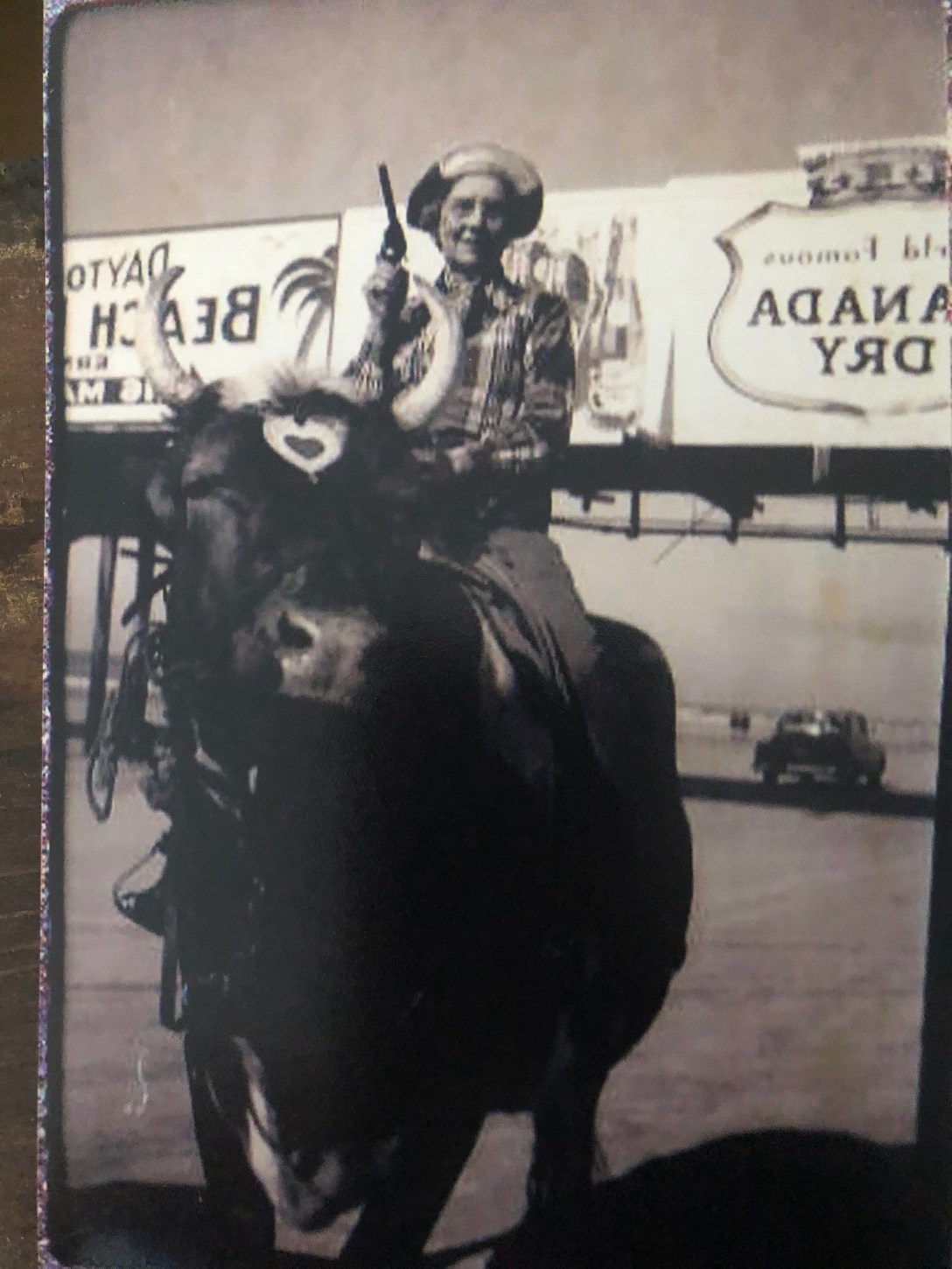
Granny loved her flowers and there are pictures of her holding various bouquets from her own yard. Mayme’s Flowers. Mom transplanted many of those perennials to her yard which are now in mine. After Granny died Mom visited her grave with those bouquets every year. I am not so diligent. I believe both Granny and Mom are in my yard tending to my flowers so I don’t have to go to the cemetery to see either of them. They are with me. There is another picture of my grandmother on one of her trips to Florida, after my grandfather passed away. It seemed to me, if pictures tell any part of the truth, that she only began living after he was gone, and her children were grown. In this picture, she is sitting atop a bull, meant as a photo op in some tourist town. She is wearing a (cowboy?) hat and waving a pistol like she might be in a rodeo. To me, this picture says it all. Or at least what I want to believe about the free-spirited soul she longed to be. I know it is only a moment in time and not a true depiction of the whole woman. Are photo albums any more than a chronicle of false memories? We set up photos to seem like we’re having the best life when perhaps the children are mad or crying or the parents are fighting. Yet, for a moment, everyone stops and smiles for the camera, or pretends to be in a rodeo. These are the symbols we create to live by, to pass on to the next generation. A false history. Still, I believe I can see her true spirit in this photo like in the one with the flowers. Her spirit is bright and she is one of the many lights that guide my way through the dark night.

I was born into a fundamental doctrine with lots of rules and fear and I have wrestled with the difference between what I know and feel in my heart and what I was taught through traditional religion. I ask God these questions directly and this week as I went to sleep, I asked again, “Am I on the right road? Will you please help me understand? Give me clarity?” I dreamed my own father—a rare visitor these days—came and told me that all roads lead to the same mountain top and that once I reached the top, I could look over the whole range of mountains and see where all were connected as one. Was that my dad? Or did God/Goddess send me a message through the likeness of the one person who instilled so much fear so I could heal an old wound and deepen my trust and faith? Whatever Holy Mystery this is, I’ll take it.   

Blackberries, 2007

Mom made all our birthdays feel special and never failed to create a celebration for each and every one. These days I don’t find birthdays especially exciting. But nature still finds a way by gifting me the ripening of blackberries. In counting down the days to fresh cobbler I offer this essay from 2007. Although the children referenced in this piece are older, I am not. LOL But, I am a grandmother now so it’s time to pass a few traditions to the next generation.

Donna M. Crow

The nurse remembered Mama, the one with purple fingers, who had her babies in July.  Those purple, briar pricked fingers, the first to touch my face, must have left their mark.  But, not so anybody would notice, not for a while anyway.  It’s like the disappearing ink in the cereal box that only re-appears in certain light, and it’s taken years. 

We followed Mama out to the field, buckets in hand to pick enough for canning, making jams and cobblers.  I complained about the heat, the briars, the possibility of snakes.  Funny how all those dangers disappeared when playing spies, hiding in weeds or climbing trees.  I was a poor hand to do any real help for Mama, but I was there.  I was convinced blowing real hard would remove the chiggers.  My belly filled faster than my pail, but Mama never complained.  If we helped even a little, we got credit for it.  She bragged on us when Daddy came home from work and sometimes, I believed her myself. 

Most times though, Mama donned the early morning path without us, dew heavy on knee high boots, finger holes cut out of gloves, and did more work before we woke up than we ever thought about doing.  By the time we woke, the berries were washed and prepared for the next step, and breakfast was ready.  I preferred the berries sprinkled with sugar to any cobbler or pie.  So, she always saved a bowl out for us to eat while she was preserving the rest for a winter’s feast.     

On cold mornings, under heavy quilt, when I was reluctant to get out of bed, Mama spread the taste of summer on fresh homemade bread, near a crackling fire place.  Nothing tastes sweeter as your backside warms against a morning fire.  I became a human rotisserie, taking such luxury for granted.  It’s taken years to appreciate the little things.  But what I wouldn’t give on a cold winter’s day for a fire someone else started and homemade bread and jam someone else made.  Come December, forget the presents, it’s Mama’s blackberry jam cake that tells me Christmas is here.   

Each year now, near my birthday, I watch the berry patches waiting for the first black to appear.  When it does, I stop on the trail for the taste that tells me summer has truly arrived.  And, the marks of my birthright begin to show, one fingertip at a time as I make plans for the harvest.

Though my teenage daughter has only a slight interest in the berry patch, for now, I can see purple stains splotching her memories.  I recognize it in her eyes once the chiggers have been washed off and she’s sitting in front of a fresh bowl straight from the patch.  I see it in the winter, when we are weary of the cold and summer is as close as thawing out a bag of wild mountain blackberries.  She is proud of making her own pie. This year, we tried dumplings for the first time.  She loved them. 

But, it’s my married son, who has fully reached the age of appreciation and is often my partner in picking.  He is becoming known as a great cobbler maker in his own right, maybe better than me.  We don’t settle for only those patches conveniently located.  We have gone deeper and higher and found the fattest, juiciest berries, our location top secret.  Once the season starts, we check our calendars for every opportunity to hit the woods.    

I feel close to God out there, in the thicket, milk jug cut open in the front, handle attached to my belt, leaving both hands free to gather what is given, using nature the way it was intended.  I know summer is fleeting and blackberry season lasts only about two weeks.  It’s like a fever with me, not wanting to miss a single berry.

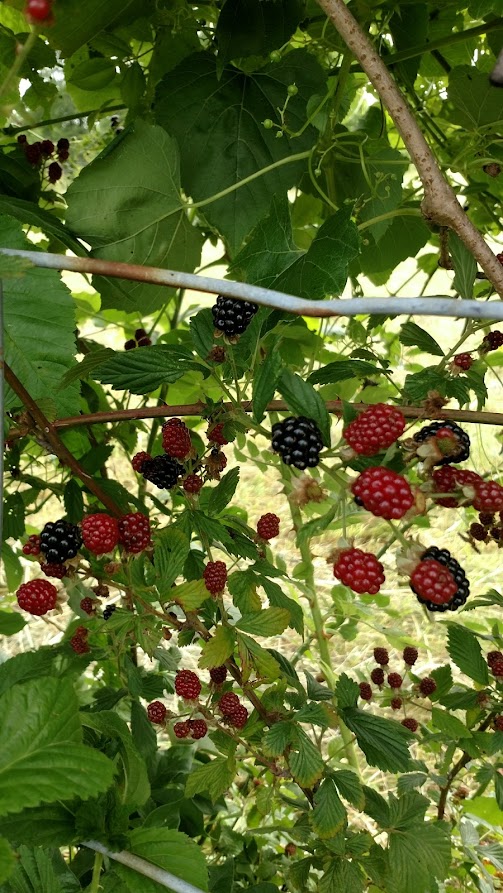
I have become a berry picking machine.  I never eat while I pick.  Sometimes I feel greedy, though, leaving few behind for the birds and snakes.  I do little picking at the edge of the path, where the berries have blackened too soon in the sun’s harsh rays.  The edge dwellers, rushing to their demise are sometimes knotty, tougher to pluck and bitter to the taste.  It’s the ones farther in that catch my eye, make me forget about snakes as I wade deep into the thicket.  Only when I become completely entwined in briars stuck on all sides, one with the vine, do I find what I’m looking for.  They are a lesson in patience, having rested beneath the shade of a Tulip Poplar leaf, breathing in the cooler mountain air.  The sun’s warm rays dancing through the leaves in perfect proportion to the moisture sipped through root straws, a sweet vacation.  They are the ones, bigger than my thumb, that fills a gallon jug in ten minutes.  They make me reach farther, take chances with footing and fall into holes.  They are my berries, put there for me.          

I’ve heard it said, “You’ll know who you are, when you know where you’re from.”  I believe I am from the blackberry patch, marked at birth, by Mama’s purple fingers. 

Aliens

Beneath the large Black Gum Tree in our front yard, the one whose roots made occasional appearances in the dirt of our Hot Wheels racetracks, my brother David twisted a tire swing around and around until my feet were high off the ground. While he twisted, he whispered to me that the two of us may not belong in this family. He came up with this theory that our real parents had been abducted by aliens because we seemed so different from everyone else in our household. I was inclined to believe him. If it had been my story, told today, I may lean toward he and I being the aliens dropped into this unsuspecting family, because we were two of a kind in a foreign land. 

We’d never been told that Mom had been married before, prior to meeting our father. Dad had been helping her raise the two black haired/brown eyed children, whose own father was M.I.A., a few years before David and I came along with our fair-haired English/Irish complexions. By the time I was born, our oldest sister Barbara was almost 12, brother Butch had just turned ten. David had only been scoping out the planet a short while and already had made a few discoveries he couldn’t wait to share, like different rules for different children or how some kids have extra sets of grandparents which translated to extra Christmas presents. I arrived two days after his third birthday and I like to believe he considered me a gift.

Dad held him up in the nursery window where I and some of my future classmates were displayed and asked him which baby he wanted. Born a few weeks late and weighing in at 10 pounds and 21 inches, I was born tall and old. David was in bad need of a compadre and I looked like I was off to a good running start. Even the doctor claimed he’d delivered a three-month old child!

“That big one,” David pointed. Out of a half dozen babies, he picked me!

“Okay, son,” Dad said. “I’ll have them wrap her up, so we can take her home.” For years, David believed it. He liked to remind me that he was the one who sprung me from the hospital and that he could also send me back. (I have since checked the roster for kids who would have been in that window at the same time, and I can say Thank You Brother D for not sending me home with any of their families. Shoo-Weee! Even if ours were abducted by aliens!) For his part, he was happy to have me deflect Barbara’s attention away from dressing him up like a girl.

Barbara was the age most girls are when they begin to pay attention to real babies, too old for dolls, too young for her own children. With two brothers she was primed and ready for another girl. In some ways it seemed I half-belonged to her. Whenever Mom had asked her help with David, she had used him as her dress up doll, putting him in a dress and painting round red circles on his cheeks, a bow in his hair. I was real, better than make believe, however short lived it was. She was over babies and children by the time our youngest addition, Angela, was born four years after me.

With Angela’s arrival we were a family of seven in a five-room house. We tripped over each other and shared every material thing. Besides clothing, sometimes even our thoughts were handed down. When it came to sleeping arrangements, we were divvied up along gender lines in small alcoves on opposite sides of the living room. Until I was six years old, I slept with our half-sister Barbara, while David was sequestered on the other side of the house in some arrangement which included a half-bed, a couch, and our half-brother, Butch. Angela, the baby, slept in a crib next to our parents in the only room with closing doors. 

The house was a 4-square. Every room had two doorways so that you could leave one room and enter another, then another and another until you returned to where you were originally. As children, we used this unending circle within the square to chase each other. On one corner of the square, a bathroom had been added where none existed before. On the opposite corner, a porch had been closed in for extra bed space.  

It was no secret Barbara wasn’t fond of children. Most of the time, David and I had the impression we were merely “tolerated” by both our older siblings. Barbara detested having any of our friends or younger cousins around. She complained and usually left the house before they arrived. Her bonding as a mother figure was strictly limited to me, and viable only at night when everyone else was asleep. She rarely had anything to do with me during the day and nothing for Angela.

Butch was a prankster. He liked to pick on his sisters, play ball, laugh and hang out with friends. Oh, and listen to oldies music on a stereo we were forbidden to touch. He was gone a lot. I snuck in his room (the boxed in porch area) and snooped and touched all the things while he was away so what I knew about him came from my observations more than actual interactions, until I was older. 

Although I shared a bed with Barbara, you could hardly call ours a bedroom. It was more like a glorified hallway on the way to the only bathroom in the house so that everyone had to walk right past our bed day or night. This invasion into her privacy, irritated the teenager who seemed to me had already grown up. Any privacy I would find in that household came from hiding behind a toy barrel in a very small shared closet, pretending it was my own room. I hid there for hours until someone realized I was missing and came looking for me. My late-night bonding with Barbara included her angelic voice singing my favorite songs and lightly running her fingers up and down my arms to relax me into slumber, a technique learned from our mother. She sometimes shared secrets with me which made me feel special. Sleeping in the bed with Barbara created a symbiotic emotional bond which tethered us until her death in 2013.

From the beginning, I knew too much for my own good without the words to understand anything at all. I know now I was soaking in the energy from those I loved. As an empath, I was sensitive and thoughtful and easily worried. David lightened my load by being responsibly caring and funny as hell. I could pretty much count on him to say what was on his mind. My vivid imagination happened only while I was asleep. During the day, I carried the burdens of my well-meaning and good parents’ unspoken and emphatically denied emotions and because they denied the truth, I came to believe I could not trust my own intuition–or my dreams (which I now know were trying to clue me in.) I became a lifelong seeker of truth without always believing it when I saw it. This was exhausting work and tamped down any creative or imaginative endeavors.

At the time of David’s tire twisting alien explanation, the one and only living grandparent that we all shared had recently died, leaving Mom in grief. Barbara had moved to college which in itself was an adjustment in sleeping arrangements if nothing else. Especially for me, losing my night-time security blanket. Further, Barbara had become a girl gone wild, lending to Mom’s despair and our parents were beside themselves with what to do about her. Mom cried all the time. It was 1968. Barbara was diving headlong into the hippy scene, free love, drinking, pot smoking, and mixed-race dating which led to a mixed-race marriage, which led to dropping out of college, which led to racial discussions, all topics that were not allowed in our household. Barbara was blazing a trail on which we would all be singed.

Butch, for me, was the stereotypical older brother who picked at me and chased me into the bathroom with his friend’s boa constrictor wrapped around his neck. But he was Barbara’s younger brother—Irish twins—only eighteen months between them yet they had never been close. Unlike the easy camaraderie between David and me, they were separate satellites orbiting our familial habitat, with occasional thunderous clashes. During our alien invasion period, words were spoken between them that would never be taken back. Yet, none of this was spoken out loud where children were supposed to hear it. What we overheard by accident must be surmised on our own and through our own lens, then added to the palpable tension in the room. Of course these people were abducted by aliens!

Mom was trying to wean me to sleep alone but I was having none of it. I was prone to nightmares and when I woke, I yelled for what seemed like hours for Mom to come to my bedside. In reality it might have taken a whole 3-5 minutes for her to make her soothing appearance and shush me from waking the whole house. She had to cover my windows with sheets and load my bed with stuffed animals for protection. I had also taken to sleep-walking, and went straight for the door, apparently trying to escape while the rest of the house slept. If I coaxed Mom to lie down beside me, I held her tight so I’d know if she tried to move. Poor Mom. With a two year old in tow, I doubt she ever got much sleep. Soon, she placed the backs of chairs against my bed so she would hear if I got out of bed. Instead of lying beside me when I called, she sat in one of the chairs so she wouldn’t get pinned down, still tracing her fingers across my back and arms until I drifted off.  A couple of times, David was dispatched to sleep in my room, probably to give Mom a break and before long my little sister Angela became my roommate and protege, thus shifting my role from little sister lost to big sister mentor. Angela was born into changing times. She and I shared quarters for the rest of our years in that house together but unfortunately, I would never be as good to her as David was to me.  

Those early nights with David made for good black op planning sessions. We utilized our best spy techniques, learned from The Man from U.N.C.L.E. and pledged to watch, listen, learn and report back any alien activity. David was a keen observer and where I took everything to heart, he saw absurdity and was able to turn any situation into a great story or cartoon drawing, getting to the heart of the matter in a much healthier way than my rumination. We made a good team. I was his greatest fan and best (aka captive) audience. He made the jokes and I laughed.

I was the Robin to his Batman, the Tonto to his Lone Ranger. We were shoulder companions, forging through our world like superheroes with towels pinned to our shoulders, searching for clues. We fought invisible foes, pretending to be tied down on a conveyor belt, inching toward the doom of a sawblade. We’d borrowed this scenario from a real episode of Batman and Robin. To save ourselves, we used what we had on us, shoes. We took turns throwing a shoe toward the pre-designated shut off lever that would stop the saw and the conveyor belt. Our mark was one particular knob on a dresser drawer. If we missed the mark, we inched further toward the saw!

We founded a neighborhood club called The Eagle Eye Investigators. When the neighbors got involved, we sometimes chose sides, boys against girls and became each other’s temporary enemies but if things got too rough, I knew David always had my back. By the end it was always us against them. As big brothers go, he was the best, always including me in the fun and never outgrowing my presence or trying to get away from me when his friends were around. Except for when the aliens landed, we had an idealic childhood.

Somewhere along the line, I changed the narrative of the alien invasion to my being adopted. I felt things that I could never explain or put into words and had nobody to tell if I did. Sometimes I thought I must be crazy. Like a good investigator, I gathered my clues. They are as follows:

  1. I was in the kitchen looking through the junk drawer and found a box of wooden matches and a candle. I loved the rough scratchy vibration of striking a match and the blue/yellow flame that followed with the sound of gasping breath. I lit the candle. Then, I took other matches and held them to the flame to watch the spontaneous burst. Mom came in and frantically took them away from me saying, “My children never play with matches!” Emphasis on MY!  ‘Well,’ I thought, ‘I must not be your child because clearly, I’m playing with matches.’
  2. I questioned everything. I needed to know the why of things. Against the unspoken family rules, I wanted to know why Barbara and Butch had different last names. I wanted to know why there were different rules for different children. Why Barbara’s black husband wasn’t allowed to come to our house and why couldn’t we go visit them? I must have struck a nerve. Mom said, “You say things to me none of my other children would ever say,” then she cried, which was all it took to make me feel ashamed for ever having spoken my thoughts. I internalized a gasp of separation between us and it was all the proof I needed that I must not belong here!

With all my questioning, I did get some answers, stories about Mom’s earlier life that nobody else got. Even after we were grown David did not know the name of Mom’s other husband. I learned what a step-father was and heard words like alcoholic, abuse. While I was gathering fodder for future memoirs, David was busy making up stories of his own.

I eventually found proof enough of my birth to this family in the form of a baby spoon with my name etched on it. It was wrapped in a letter from IBM where Dad worked, congratulating him on the baby girl. I had been snooping through a portable file box left unlocked in the bottom of Dad’s closet. There I was, Donna Marie, though the baby spoon didn’t look like it had ever been used…hmmm. Even if David did pick the wrong baby, I decided to be glad he chose me and that we were in this adventure together.

About a year before both our parents died, Dad found a newspaper clipping with the names of all the babies born in the local hospital during my birth week listed with who their parents were. He gave it to me, “If you’re still looking for proof,” he said.

These days all I need for proof who my parents were is to look in the mirror.