Turtle the Chimney “Sweep”

On Monday as I was leaving the office I found, at the bottom of the steps outside our back door, a mother and her teenage daughter mulling over what to do about an injured bird. As our steps lead almost directly to the street, the bird had possibly been hit by a car. It was stunned with one wing oddly askew like it might be broken. I stopped to assess the damage. It was as if we all knew, the mother, the daughter, me and maybe even the bird that I was the one taking it home.

The mother and daughter wouldn’t know this but I had once successfully raised a baby crow who lived voluntarily in our trees for quite a while after it fledged. I could come outside and yell its name and down it flew to land on my arm for a snack. After I thought it was grown and gone it twice returned injured for a safe place to recover. But that was a baby I’d once fed mashed up worms. It remembered it’s mama Crow. Crows have long memories. This bird, which I first thought was a swallow and later proved to be a chimney swift, hadn’t intentionally sought me out…or had it. Injured animals seem to gravitate toward me. I used to take evening walks to the local courthouse to watch the swifts come in. We called them “sweeps”. My work office is less than one block from that same courthouse. The bird had been injured and landed in the path I take every day. Unbeknownst to me a co-worker had seen it four hours earlier and had decided to leave it but check on it later. Then, the mother/daughter duo worried over it but had no intentions of touching or moving it. I am no stranger to animal rescue. I immediately picked it up. Because of Covid I still had plastic gloves readily available. Thanks to the Beverly Hillbillies there is probably a whole slew of women my age who grew up with the nickname Ellie May for their propensity to capture injured animals and try to nurse them back to health. That’s what Mom called me but I was rarely successful. Nature is a great teacher.

It was a hard lesson to learn but it’s often better to let nature take its course…unless I know there is something I can do. I am quicker to recognize impending death these days. But I still can’t leave the dying to die alone. In this case, my instinct to take the bird might have also been driven by my attempt to relieve the mother’s guilt for disappointing a brooding teenage daughter. I could tell they both needed to think they had done all they could. I could give them that. I took the bird because that’s what I do. I couldn’t let it lay in the gravel and grass until a neighborhood cat decided to make it a toy, or the sun dehydrated it. I thought at the very least, I’d give its death some dignity. It wouldn’t be the first time I’d provided this service. Death Doula to people and animals. Even as I placed it in a cardboard box, I dreaded telling my boyfriend/housemate about our new roomy. He wasn’t around for my dog rescue days so he may not be fully aware of my proclivities to drag in injured animals.

First, I took it to the same veterinarian who helped me with dog rescue to see if its wing was indeed broken. “Looks like it is fractured,” she confirmed. She did not set bird wings but gave me the name of another veterinarian who treated birds. Selfishly I wondered what it might cost and if I was willing to bear that cost. Domestic pets, it turns out, are the only birds veterinarians treat. I called three vets who all said to call wildlife rescue. The only wildlife rescue I could find informed me their Kentucky affiliates had no permit for songbirds which meant the swift and I were on our own. As I write this, it occurs to me, my daughter is attending the latest Taylor Swift Album release in a movie theater. She is decidedly a “swiftie”. I have never listened to Taylor Swift’s music but this little bird has turned me into a “swiftie” as well. Its slim cigar-like torso and pointed wings, the gray top feathers melting into a snowy underside and the sweet way it turned its head to look directly at me when I held it in front of my face or slowly closed its eyes when I stroked its back, made me fall in love. Its beak was as delicate and tiny and black as the tip of a cat’s toenails, but not curved. Looking straight on, its eyes and short bill resembled the face of a turtle, so that’s what I called it. Turtle. It should be said that both sexes look alike in this species and I have no way of knowing whether Turtle was male or female. I deemed her female for no good reason at all.

I hate that we rely on google for so much of our information these days but it is a wealth of knowledge. I did read in my old-fashioned bird books as much as I could about the species, but they don’t tell what to do if you find one with a broken wing. Anyway, google said to keep it still and in a dark place to prevent further injury and then immediately take it to wildlife rescue. Immediately. So much for that advice. I did start it out in a small cardboard box with a makeshift nest of dried grass. The way it climbed up and positioned itself on the side of the box made me research further and realize it was a chimney swift. Whenever I picked it up, its talons clung to my finger like a baby’s first instinct to grasp, another tip that it was a swift. Turns out chimney swifts don’t perch on branches like other birds. They fly for hours or even days at a time, taking their food on the wing. They are aerial acrobats, almost always moving. Most of their diet consists of flying insects so they are extremely beneficial to humans in that way, cleaning up mosquitos and other pests. When they do land for the evening or to make a nest, they cling to the inside of a hollow tree…or a chimney or other tunnel-like structure. Their clinging feet are necessary to adhere to vertical, sometimes slick, surfaces. I anthropomorphized this grasping behavior as if the bird were holding onto me for its very life. That kind of oxytocin release reminded me of all the dog rescue I engaged in during my empty nest years.

Hundreds of dogs I took home from the shelter, bathed and housed. (All dogs come home from the shelter with the same foul odor.) It only took the first bath after leaving the shelter for a dog to follow me faithfully and make me their person. I knew what I was doing while I was doing it—avoiding the pain of my daughter’s impending exit, the truth of my dysfunctional marriage—but I ran into all kinds of rescue folk over the years who were unaware of the lonely hole they were desperately trying to fill. It’s easy to believe an animal loves you when you’ve intervened on their behalf. For the most part, I kept my head about me. The veterinarians I worked with liked my ability to be realistic. Once I knew a dog’s personality, I ran a match-making service with local families to place it in a forever home. I became addicted to learning each personality and it’s true the feel-good sensation of unconditional love is immeasurable. Rescue work is rewarding, but dirty and filled with harsh realities.

I was right about my boyfriend’s response. Gregg was mostly concerned about diseases and insisted I disinfect every place I’d even set the box. I explained that the bird was in a small box which was inside a bigger box so there were two layers between it and any surface. He didn’t buy it. I googled again to find that chimney swifts aren’t known for carrying diseases and are no threat to humans. Sometimes their nests attract mites but I had no nest. Histoplasmosis is a fungus that can grow in bird poop once it has composted but it doesn’t exist in the poop itself as it comes from the bird. I hoped this might waylay Gregg’s fears but I doubted he’d be any happier. He insisted I leave the bird and its box outside.

I wondered how I was going to feed “Turtle”.  They prefer to catch insects in the air but that was not likely from inside a box. Although I did catch a couple of spiders and a fly for her. She was either not impressed or still in shock from the jolt that upended her carefree existence. The book said when insects were scarce swifts would eat seeds or berries so I placed both in a shallow dish alongside a saucer of water. I knew not to force feed with a dropper for fear of setting up pneumonia but I did offer a droplet near her mouth and it opened for two swallows of water.  

After the first night, I thought the tiny bird needed some daylight to inspire its recovery. I didn’t have a bird cage but I exchanged its dark box for a small cat carrier. I attached hardware cloth on the door’s grid to prevent escape or the patient’s cock-eyed wing from getting stuck through the openings. The new space brought new movement. That screened door became her favorite roosting spot since it was easy to hold onto. I still couldn’t tell if she was eating but the food got dispersed as she moved about the cage so at least she knew it was there. Gregg knew I was concerned and joked that I could tie its feet to a string and swing it in the air to catch insects. He thinks he’s funny. But then he did have an interesting idea of putting a piece of fruit in the cage to attract insects, which I tried.

I didn’t have any real expectation that the bird would live. I thought at most it wouldn’t die by predator. But as one day turned to two and then three with more activity each day, I started to think of possibilities. I decided I’d give it a couple more days in the cat carrier and graduate it to a dog crate. I have a large one left from my humane society days because with me, you never know. I would create a chimney in one corner so it could roost properly and if I saw it gliding down from there, even for two wing flutters, I would find a safe place to open the cage and see if it could take flight. Then, I worried that it would live but not fly. Was I prepared for long-term care? What kind of life would it be to go from aerial freedom to living in a cage? Neither of us wanted that. I envisioned building a greenhouse, something I’d been wanting anyway, so it could have some semblance of an outdoor life. It was curious to me how many images google had of chimney swifts sitting in the palm of someone’s hand. I had taken that picture myself. Most bird pictures aren’t featured in someone’s hand. Do people make pets of them? I read that some swifts have been known to live as long as 12 years in the right conditions, yet the average lifespan is about two years. I had no idea how old this bird was. She looked so young and delicate to me yet she was the size of a full grown swift.

Then, on Thursday night, she died. It had been her most active morning and I’d seen her climbing the wire door in the middle of the day but by nightfall, she lay face down on the bottom of the cage. She could have starved but she pooped every day so I thought not. Maybe her body couldn’t take the shock. My guess after the fact is that she had an infection which I had not known to treat. I know she would have died anyway, without my intervention. Still, I wish I could have done better by her. I really don’t know how I would have administered antibiotics but I will think about it next time…because…there will be a next time.

 I am grateful to Turtle for bringing me a whole new awareness and appreciation for chimney swifts. They are amazing creatures with a soft heart and a gentle soul. I don’t know if I made what was left of her life better or worse, but I know this: Death is a sacred act. I have witnessed it many times, with humans and with animals. It is sad to say goodbye, but it is an honor and a privilege to hold space in those last holy moments. At least she didn’t die alone. Fly away, little Turtle, fly away.  
Nature-The News to Watch

Anyone who knows me enough to talk to me knows I’ve been obnoxiously in love with my garden over the last two years. “What have you been doing lately?” followed by “Let me tell you about my garden.” Maybe this is because I’ve always wanted to be the kind of person who raised and preserved her own food like my parents had or my friend Kim who makes it look easy. But it’s hard work so I’ve failed gardening miserably in the past, ambitiously planting but not keeping up with the weeds. It has taken me years to construct a system that works for me. One that doesn’t overwhelm me when crabgrass takes over. I’ve landed on a series of raised beds that I can tackle one at a time. Flowers here, vegetables there. Some perennials, some annuals. An aesthetically pleasing array, and, oh, the birds! My Merlin Bird Identifier registers 10-15 birds’ songs every morning. We have regular families of Mockingbirds, Cardinals, Redwing Blackbirds, Doves, Indigo Buntings, Flickers, Warblers, Finches, Wrens, Robins, and of course Crows and more. You name it, ours is rich with variety too many to name properly. I’ve even seen a Boston Oriole and a Yellow Billed Cuckoo!  Working with the earth and nature spirits has been my saving grace. Something I can put my hard work and love into and reap the benefits. People will disappoint. Nature rarely does.

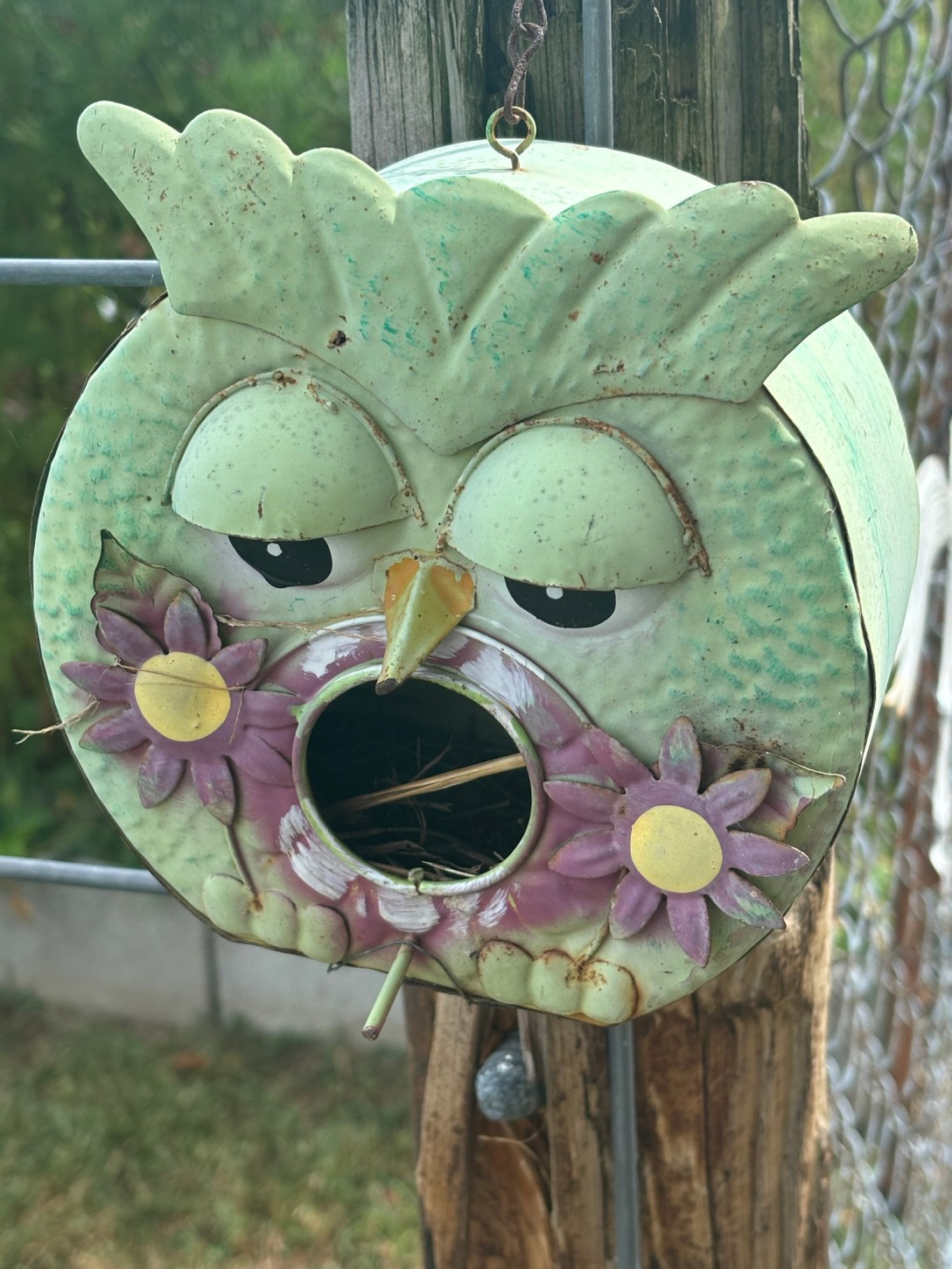
After building the raised beds, we hung cattle panel fencing around the garden with gates on three sides. I was so proud of my design I wanted to decorate it with more than flowers. I attached metal art panels on each of the gates and placed a gazing ball in the middle of my herbs, I hung a small metal birdhouse in the shape of an owl’s head with a small round opening for a mouth. A cruel joke but so very cute. From the top of its head was a dainty little chain and hook so I hooked this over a nail at the corner gatepost so I could see it from the house. I truly thought of this little owl as ornamental and not as a real bird house at all, or else I would have attached it with more vigor. Yet, all summer I have enjoyed watching a pair of Eastern Bluebirds return to this box time and again, climbing in and out of the owl’s mouth with dried grass from our compost or food for their babies. The box is eye level so I can sneak a peak each time I enter the garden.

From my usual spot on the back porch where I sit in the mornings with tea and a journal, or in the gloaming of day’s end, the garden with its little family of bluebirds is in my natural gaze. Behind them, a stand of cosmos. Beside me, a pair of binoculars. From my seat to the garden gate is approximately 50 feet. There is a boxelder tree between us that gives shade to the yard and holds a hammock. The garden gets full morning sun and then the tree protects that little metal birdhouse on the corner from getting too hot in the late afternoon. The first time I saw the birds furnishing their nest, I was a child again, only now I didn’t have to tiptoe or have my dad hold me up to see inside. Before long I was counting eggs, waiting for them to hatch. I watched each day as the couple took turns being in the box or keeping watch on the fence adjacent to it. Once I saw Papa fight off a larger bird that came too close. One evening when Mama and Papa bird must have been on a date or on a run to the grocery, I absentmindedly went to work in the garden without peaking at our babies and they squawked at me with their mouths wide open. If I’d had a worm, freshly chewed, I’d have dropped it in their eager beaks for sure. I felt like their nanny. I anticipated seeing them fledge any day and watched them closely so I could monitor my dogs’ activities and keep the little bundles of joy safe as they shored up their confidence. But the next afternoon, they were gone.

My first thought was not the grave one. Had they fledged during the night? Had I missed the flight while I was at work?  Were my bluebirds so gifted at flying that they didn’t need practice?  They were perfect, after all. Of course, I did land on the idea that something terrible had happened, after I went inside my garden fence to find a smattering of downy feathers peppering my beans.

The parents wasted no time cleaning out the box. Before long they were remodeling with new tufts of straw. I admired their tenacity. Maybe that’s how they grieve. I remember keeping myself busy when experiencing my own empty nest for the first time.  And this gardening surge came along at a time when I needed the earth’s grounding and something to look forward to. Again, I watched their progress, counted their eggs and waited. In the meantime, I googled natural enemies and predators of the eastern bluebird. I found all kinds of ideas for protecting the box from predators.

We live in a healthy ecosystem on our farm by the river. We readily hear and see hawks, owls. We even had an eagle land in our yard once, but he was eating a groundhog. Too big for that little birdhouse. Rabbits are everywhere this year. I imagine that’s keeping the pack of coyotes happy who we mostly hear at night, down by the river. We watch parades of deer and turkey daily. We occasionally smell a skunk who’s perfume wafts in an open window at night and signals the dogs to bark. The peepers in the barn lot pond are deafening at times, especially if it’s going to rain. When I run the soaker hose in the tomatoes, I almost always see a fat bullfrog enjoying the puddles left from a leaky faucet.

I know there is death on the farm, I’ve witnessed it. Coyotes having Thanksgiving Turkey, Bobcats catching rabbits. Mockingbirds stalking and desecrating Luna Moths—which  I find especially egregious. Sometimes the beauty and wonder of nature is so brutal it can break your heart wide open. What I haven’t mentioned is obvious. Google says the snake is #1 on the list of suspects. All of the friends to whom I’ve mentioned my bluebirds say, “Snake.” I say “I don’t think so.” Here’s why: 

  1. That smattering of feathers left behind. Another bird or a racoon would leave feathers behind but maybe a snake would swallow whole?
  2. We mow about an acre all the way around our house and garden. We and/or the dogs are actively in the yard every day; claiming our territory.
  3. The bullfrogs haven’t been snatched yet.
  4. Most Important** and this is the kicker:  I made a pact with their leader, a 6-plus foot black rat snake that I found on my porch one night (that’s another story) just after I moved in. I told her we had 140 acres here and if she would spread the word among her kind that I live in the house and the mowed part of the yard, they could choose their territories over the rest of the farm. The house had been sitting empty a few months. Maybe she had been delegated to check out the new neighbor. I requested she take the barn lot closest to the house to keep the poisonous snakes farther away. A rumor I’d heard but she said nothing, although she did as I’d suggested. She already understood the benefits of that location. I leave them alone. They leave me alone. We’re all happy.

     This has been a good partnership for 12 years now. We sometimes see a random snake in a field, near the barn or on the road but for the most part not close enough to the house to have a reminder talk with them. I’ve only broken my end of the bargain once, last year, when I wanted an old wagon wheel for my herb garden. It was lying in a pile of antique farm equipment I call “the boneyard”. Several wheels and other pieces of antique mule driven farm equipment had been abandoned in the barn lot and overgrown in upstart trees, shrubs and tangles of honeysuckle since my dad traded his mules for a tractor in the early 70’s.  It looks like where the 19th century went to die. I’ve seen my snake friend and her family there many times, on my walks. It’s the perfect location between a barn full of mice and a pond for frogs and drinking water. I knew I’d have to breech my contract with her but I hoped to be in and out without notice. Don’t get me wrong, I’m still scared of snakes. I don’t want to see one, and especially not be close enough to touch it, although I will give a snake a good talking to if I do see it. I’ve always known she was there and I’ve left her alone. I asked my companion to help me recover the easiest wheel I’d spotted and we donned our knee-high boots and work gloves and hiked over. As he pulled and cut and sawed through tough vines, I talked to her and apologized for coming into her home. I hoped she would forgive me. Turns out, she was wrapped around the very wheel we were pulling on. She disappeared quickly into the brush and we both jumped. I continued apologizing, profusely. I looked like a child hopping on one foot and then another while flicking my hands to shoo her away. I wondered then about payback but soon forgot as the spokes of the wagon wheel—lying flat on the ground—made a great dividing frame for my sage, rosemary, thyme and oregano.  

My little bluebirds continued to teach me about persistence, making 2 more nests in a row. Again, I watched, counted, waited. Nothing. No more feathers were found but neither did I witness hatchlings learning to fly. The evidence was mounting but I hoped and decided that without seeing feathers, I’d simply missed their flights while at work. Three times! I was happy and surprised when the birds came back for a fourth time, cleaning, re-stocking, preparing.

            A few days ago, I went out to enjoy the sounds of morning bird frenzy, as usual to collect a few minutes on a cool porch before the heat set in. Our days have been scorchers lately. To my surprise, dangling from the lowest tree limb of my backyard box elder, within ten feet and direct eyeshot of the owl’s open mouth, was the shed skin of a snake, about 3 feet long! Too bad the owl isn’t real. The skin did not belong to my friend the reptilian Queen, who I’d put in charge, because she is much longer than this interloper. One of her not so loyal subjects had snuck into forbidden territory!  

            As I sat, contemplating how to renegotiate peace talks, my partner told me he’d found a baby copperhead enjoying the heat of the compost pile about a month back. Although he’d killed the one he’d found I realized chaos had ensued without my knowledge!

            “A baby?” I asked, “Only one?  Are you sure there weren’t more?” Youngsters can go rogue without yet knowing the unwritten rules of their elders. That’s understandable. But as every old person says, this younger generation has a different set of values.  Leaving the skin in both my view and that of the birdhouse, is a blatant show of disrespect. Also, I was aware this was supposed to be the year of the cicada invasion. Although our region hasn’t been the hardest hit, for months now, Rosie and Willow—otherwise known as dog patrol or affectionately “the girls”—have been staying out late to dig for beetles or cicadas or whatever other little crunchy larvae might be there. I’d read an article about snakes gathering beneath oak trees at night to eat the emerging cicadas and I hoped my girls were abating that possibility.

            I wasn’t sure if Queen Rat Snake was dead, if there had been a coup for leadership, or perhaps she felt I owed her one after my breech into her territory last year. Maybe she decided staying out of my yard in a cicada year was too much for me to ask.

            I went back to writing in my journal, listening to the usual morning rush of cardinals, jays and mockingbirds as they come into the garden for breakfast when I heard a flush of excitement. The bluebirds were back. They had spotted the skin and were sounding all the alarms. Mama was flapping her wings hard, hovering in front of the scaly replica, and if I had to guess cursing him mightily. I hoped she didn’t have a heart attack. I could almost feel how the realization hit her. Grieving her babies while finally getting closure for where they went. This brought Papa. They flew above it, below it, hovered in front of it, flapping their wings and yelling as if to scare it away. It didn’t budge, of course, except for wavering in the wind. The birds called in the cavalry and here came the flickers and mockingbirds, a larger line of defense. They too used their best scare tactics and sounded alarms which pulled in the officers—cardinals and jays. With all the sirens going off, it was the only show to watch, even the dogs were captivated. We were the rubberneckers at the scene of a crime; all traffic stopped. It seemed the teams had forgotten their colors and all acted as one unit to rid the area of this menace. They did all share the same feeders, after all. When the decomposing skin did not respond to their fury, except to sway with the breeze, they finally lost interest and gave it up for dead.

The skin still hangs as a reminder. My hammock chair also hangs in that tree. It’s the only tree I’ve got whose limbs are hammock or swing friendly. I’m not sure how long it will take me to sit there again, unsure what might be overhead. I know the bluebirds have not returned to their box. As with all trauma, it’s gonna take time. Well played Queen. I won’t be taking you for granted again.

Alchemy

Alchemy: a power or process that changes or transforms something in a mysterious or impressive way.

I went to dinner in Lexington with some women. Friends, and friends of friends. Three of them had birthdays in the same month so not only was there reason to celebrate, after dinner we were attending a reading by another friend who was celebrating the release of her latest book. A night out for the ladies.

Since we had gathered primarily for the literary arts, the dinner conversation began with literature. Who recently read what, which books are must reads, what we’re currently writing, and morphed into general story telling since most of us were writers of one form or another. One person’s story reminds someone else of a similar story, reminds another, and so it goes. In this instance, we traveled the world going from Chicago to Milan to New York and all the way back to Kentucky, where we all currently live. One theme that emerged was housing. From tiny squeeze-ins to expansive high-rise sublets to starter homes, the ladies spoke of lucky breaks, exigent circumstances and turning bad situations into good. I saw a theme emerging.

“Alchemy,” I said.

“What’s alchemy?” my friend asked. I explained poorly that it was a term referring to the medieval attempt to turn base metals into gold. But that today it also meant just what she had been saying, how she’d turned a bad situation into a good one.”

Then, “Martha’s” Kentucky story of purchasing a farmhouse without prior knowledge of the den of snakes who had taken up residence beneath the front stoop drew gasps from everyone.

            “I’d have to back out of the sale,” one said.

            “Or put it right back on the market,” another chimed in. “You didn’t stay there, did you? Is that where you live now?”

The fear of snakes always sparks eeks and cringes followed by other close encounter stories. I’d venture to guess we all have snake stories. These ladies all did. The fear of the serpent is likely the most common phobia. We love to hate these creatures.  

I, too, am no fan and prefer not to get personal with a snake.  I thought about reminding us all that snake symbolism was originally that of the divine feminine and that maybe we had been conditioned to fear snakes based on the patriarchal need to control the innate power of women. According to Ted Andrews’ book Animal Speak, seeing a snake denotes resurrection, renewal, rebirth (shedding of one’s skin to become anew). In dreams, simply encountering the snake is thought to be the subconscious awareness of a pending new cycle of life. Being overly afraid of the snake symbolizes fear of the changes necessary for internal growth. Getting bit might symbolize the level of resistance or blocks you’re throwing into your own path. I’ve had plenty of these dreams throughout my spiritual awakening journey as well as in person sightings. An explanation like this might be interesting, but it rarely does much to allay a well-honed fear of snakes. Thinking of the power of transformation, I juxtaposed one of my own snake stories instead.  

I am the third generation of my family to inhabit the family farm, in a house that was built in 1901. Dad refurbished the house, mid-seventies. Insulation, Drywall, paneling, popcorn painted ceilings and area rugs turned the place around, even before electricity or plumbing was added. Instead, fireplaces, a Warm Morning stove, outdoor toilet and a rain barrel became our every summer adventure, heading back to a small abode with a thermostat and a real bathtub during the school year. We merrily frolicked at the river’s edge, raised cattle, pigs and chickens, the occasional mule, helped Dad with tobacco, hay, planting and harvesting vegetables, hunted arrowheads, shot BBguns, picked blackberries and maintained a healthy awareness of snakes like we lived in the 19th century. In his head, my father sort of did. I was having the time of my life. Today, I am grateful for this character-building years-long sojourn into the past. My parents installed plumbing and a few other upgrades and moved into the farmhouse after all of us children were grown, around 1991. 

In 2012, due to Mom’s cancer and other circumstances, my father bought a house closer to town and nearer to doctors and the hospital. The farm is isolated with sometimes inaccessible country roads. Since I was freshly divorced, he convinced me to take up residency on the farm so that the empty house would not get vandalized or become a drug den.

In the seventies, Dad didn’t believe in the future of electricity or otherwise could not envision the number of useless appliances the next generation would find not only convenient but necessary. He felt ahead of his time including two whole outlets per room. Re-learning how to live in an old house whose electricity has not been modernized to meet today’s standards and whose prior inhabitants had learned how to “make things work” without actually having them repaired, included several “combinations” of actions I needed to learn to keep the house running smoothly. Namely, deciphering the tangled web of which outlets in how many rooms, both upstairs and down, whose wiring led to the same 15-amp fuse. I should have bought stock in Buse fuses for the number of boxes I purchased and went through in those early months, grateful they still existed.

Another thing he made sure to tell me was about the relationship he had formed with a huge black rat snake that lived in the shed out back. As I’ve indicated, snakes aren’t even my favorite subject, but out of reverence to my father, I listened to his tutorial.

            “You know I store feed in that building, for the cattle. Mice get in it and make a big mess. That big snake keeps the mice and rat population down so I like him being in there. He’s not poisonous and he never bothers me. When I go into the shed to retrieve the lawn mower I talk to him, warn him I’m coming in. He may be hanging from a rafter or laying on the ground someplace. I pull the riding mower out and start it up. When he hears the engine, he comes out and makes his way down toward the pond. I guess he’s getting a drink. I don’t see him again until after I’ve finished cutting grass. Later in the evening, when it’s quiet, I can sometimes see him returning to the building. We’ve been doing this for years. We made a deal.”

            “Okay,” I tell him, “I can live with that.” Even though secretly I thought, okay then, I’m not going in that shed, which turned out to be impossible. So, I did indeed follow in my father’s footsteps and tried my hand at snake whispering, which might or might not sound more like clanging and banging and yelling warnings rather than actual whispers. I named the snake, Earl.

Dad cut more grass than the immediate area around the house. He had cleared and tamed almost an acre of land, to keep the snakes at bay, he’d said, even though he made exception for Earl. He thought it wise to claim territory separate from the wilder fields and fence rows that bordered the woodland’s edge to provide a clear view of encroaching wildlife. He advised me to do the same. But since he took his riding mower with him to the new house and I still only had a push mower, I hired a neighbor to keep my lawn tidy. I told him the snake story and asked if he could please respect my father’s wishes and look out for Earl. “It’s been there for years,” I tell him. “It doesn’t want to harm anyone.”

Vernon was on the lookout for Earl, no doubt. His first encounter with Dad’s rat snake shocked them both. He entered the shed looking for a weed eater. The lanky sentry hung from a rafter at eye level as he entered, probably wondering who the hell this guy thinks he is entering Herbert Crow’s field mouse buffet. After that, unbeknownst to me, Vernon began strapping on a sidearm before arriving to mow the grass.

After a month or two of cutting the grass with no further incidents I thought all was well. However, one day, Vernon gave in to his own fears and ignored my sentiment about the friendly cohabitant of my abode. He knocked on my door, and using a hoe to extend his reach and not actually touch the old guy, held out his conquered prey to me the way my dogs string out a dead rabbit on my doorstep…as a gift.

            “That’s Earl,” I say, confused.

            “Don’t worry, I got him,” Vernon said. “I hate me a snake. That’s why I carry this.” He proudly pointed to his waist band where he’d holstered the offending weapon. The story he told was just as my father had described, the snake heard the mower and came out of the building to head down to the pond, minding his own business. Only Vernon didn’t care where he was going. Seeing the snake, he chased it down with his lawn tractor, close enough to get a good shot with his pistol because he sure as hell wasn’t going to get off that mower and possibly get bit. He also wasn’t going to let it out of his sight for fear of where it might go…and…he didn’t want to miss. Poor Earl had made it all the way to the fence row, about to cross the threshold to safety before he felt the blow. Vernon was proud.

My father had warned me about the snake we’d named Earl. But we both failed to warn Earl about the viper named Vernon.

            “Oh, that’s so sad,” said the lady who would have instantly sold Martha’s den-of-snakes’ house.

“I can’t believe he did that!” said another. “Did you let him keep mowing your lawn after that?”

“Do you hear how you have all changed your attitudes from loathing to compassion and concern for a snake?” I ask, “Now, that’s alchemy.”         

Grow Where I’m Planted

I can be hard on myself, especially in winter when I’m not as productive. In any case, I knew better than to set myself up to fail with a new year’s resolution. But I do like to think of each new year as a fresh start, unscathed by failure, and filled with possibility. My adult daughter told me she was choosing one word to set a theme for the year. I liked that notion.  After a day or so of discernment, the word that came to me was, “open”. 

“Open”. Open to new ideas. Open to new opportunities. Open to new ways of seeing myself and others. Open to change or at least to be a tiny bit more flexible in my perceptions. Maybe even travel more.

I was invited to a friend’s annual birthday party which always occurs mid-January and can be quite a pick-me-up from the doldrums. On her sixtieth birthday, and every year since (more than 10), she has thrown herself a party. It is traditionally an all-women-all-day-sometimes all weekend affair. Fascinating female friends, new and old, from all walks of life come and go. There is food, drink, games, and lots of chatter. A full-grown slumber party, women of all ages schlepping around in pajamas, drinking wine. If you give in to it, it can be a time of empowerment and support. This year the party was limited to one all day affair so no pajamas but good food and plenty of wine.

I have never been the kind of person who could throw themselves a party although women should probably learn to celebrate themselves more. On my 60th birthday (I’ll be 62 this summer), while the earth didn’t move like it did when I hit 42—and spent a decade trying to right wrongs and get my feet on solid ground—I did feel a slight shift in perception. Another course correction in my navigation system. I stated out loud to myself and to my closest people that I am in the fourth quarter, looking at my parents’ health and longevity. This gives me another 20, if I’m lucky. Possibly only 10 of those in reasonably good health and energy. I declared that if there was something I wanted to do, I would do it. Here I am, two years later, still trying to remind myself. It takes a long time to unlearn a way of being.  

This party was my first social outing in weeks as I had been sick with Covid compounded by a sinus infection that refused to release my brain from its foggy prison. My work office closes down through the winter holidays so I guess it was a good time to be sick if I had to be. Still, I felt like I should have been reading and/or writing. Instead, I sat in a stupor for days. Unable to form a simple thought, I merely observed myself be sick. If I’d been trying to meditate—remove rampant thoughts from my head—I would have had monkey mind. In this case, it felt like my brain had been wiped clean. On the plus side, I’ve never slept so well or for so long at a time. I hoped, whether I intended it or not, having no thoughts for a suspended number of days worked as a clearinghouse to make room for a brighter year full of ideas and execution. I wasn’t really feeling social, but I went to support my friend and to be “open.”

The party was to begin around 10 AM. and last until 10 PM. I moved reluctantly through my house, readying myself for a long day of interaction. Stretchy, comfortable clothes. Black tourmaline beads on my right wrist to protect from taking on others’ negative energy. Rose quartz beads on my left to receive a positive flow of love. Blue lapis lazuli earrings for overall protection and positive energy. It couldn’t hurt. We are all made of matter. All matter vibrates at a specific frequency. The higher the vibration, the more positive the experience, like thoughts. Whether you believe in the vibrational energetic properties of gemstones or not, I believe setting intentions raises my vibrational experience. Rituals are powerful. It’s like an active meditation. Plus, I believe we find what we’re looking for. Raising our thoughts, raises our experiences. Since recently being sick of body and mind, I was feeling vulnerable and needed a little spiritual pick-me-up. Finally, properly attired, I started out the door shortly after noon reminding myself to be open.

Even if I was successful in raising my vibration, my starting point must have been pretty low. It was soon evident I was still in observation mode, hardly up to the challenge of real conversation.

As in years past, at some point during every party a circle is formed. Women take turns introducing themselves to the group. It used to be a game of telling three things, two truths and one lie. The other women in the circle tried to discern the lie. This year, the circle took a more organic conversational turn which included mysticism and spiritual journeys. From ketamine clinics to holitropic and effigy breathwork to shamanic drumming it was clear many of these women had begun the inner work of midlife, curious and open to spiritual growth and all the trending modalities. This was my wheelhouse. I started this deeper work two decades ago but even since the age of nine, I have been a spiritual seeker. When I was a beginner on my spiritual journey, I couldn’t wait to share my experiences and epiphanies but more and more since I turned 60, I have grown quieter. Maybe I’ve gained just enough wisdom to realize nobody wants to hear it. They have their own life to deal with. The circle was large. It seemed each woman spent at least 15-30 minutes sharing pieces of their best life. Places lived, jobs, interesting experiences, meeting famous people. This lasted all afternoon…hours it seemed. It was exhausting, really. While a few women opted out of the circle to graze the food table, I had grown roots on the couch, unable to free myself.

I know it was mostly because of my illness, but listening to the experiences of these women, their ability to move through life with a sense of autonomy, independence and direction, the jobs they’d had, the places they’d lived, temporarily thwarted my confidence.

My early path was traditional. Compared to the stories told, the choices I’d made felt small, unremarkable, cliche. For a writer, cliché is such a disappointment. Get married young, support husband’s career, raise children. And I might add here that I raised a stepson for many years before bearing my own child so that my child rearing years were prolonged, having raised not one, but two only children. It is worthy work and I don’t regret the dedication I gave to my family but like too many women of my generation and older, raising a family was my only purpose. I became a “we” before I became a “me”. And let me tell you, once entangled in a “we” situation, especially if one member of the “we” was not already a “me”, it is difficult to extract even a part of oneself without disassembling the whole.

**Sidebar: In my opinion, patriarchy has done a fine job selling the notion of marriage where “two become one” as a romantic notion rather than one of control.  To me, it means one of the people (usually the woman) must disappear into the shadows of the other.

I can proudly say I added two responsible contributing members to society which is no small feat (even if they did need counseling, lol), but I kept nothing for myself during those years. No matter how much I’ve grown, how far I’ve come, or what I have overcome, for almost three decades, I had no personal ambition. I never even let myself dream of choices outside of what my family members needed or wanted. I don’t think I meant to be a martyr. I was more like someone who had been brainwashed (or brainwashed herself) to believe she was not worthy.

When it came my turn to speak, I was dumbfounded. Not only was my actual voice weakened and shaky, my thoughts were still foggy. Even the most worldly of women in attendance seemed inviting, kind, yet, I fell victim to the soul deadening act of comparison. At that moment, I did not measure up. I rambled a bit. I got emotional. I passed the torch. Then, I spent two days analyzing my reaction…like any neurotic memoirist would.

I meditated on those circle conversations, discerning what it was exactly that had set me off.  No matter their life’s journeys, many of these women were just beginning the spiritual inner work that I had embarked on years ago. I wasn’t behind here. As a matter of fact, I was ahead of the curve in some respects. I’ve had years of counseling/self-awareness/memoir work. But I did start a career just as many same aged women were retiring, making me a late-bloomer with regard to choosing a personal life direction.

The thing that stuck out for me about the stories those women told was the number of oddball opportunities that had seemingly appeared out of nowhere and the fact that many of these women had seized the moment. They’d been in the right place at the right time and recognized it. They’d followed their own path, refraining from child rearing and even marriage until their own careers were off the ground or maybe doing both at the same time. How did they come about the confidence to follow their own path so young, being reared in the same era as me? Different cultures, maybe? Different role models? Certainly, different birth family expectations. Also, most of these women were not Appalachian, which may have a bearing. Nobody in all the generations of my family would have considered moving to another country straight out of college. Hell, my brother and I were the first to ever go to college.

What struck me that day, I would recognize later, was grief. There are whole parts of me that I ignored for years. Choices that I made that were clearly not in my own best interest. They may have been choices out of my control…or choices that were beyond my mental capacity at the time, but they were still my choices. I had already spent years of therapy restructuring my life, so it wasn’t new information. I knew this. I had grieved before. But that’s how grief works. It finds an opening and uses it to heal deeper wounds than you knew you had.

There was clearly something else for me to learn at this juncture. Listening to those ladies made me revisit my younger self, remember how insecure I had felt. But the gist of what they had all been saying was that they had been presented with an opportunity, sometimes not of their own making, recognized it, and seized upon it. With hindsight, I can see a number of opportunities that had presented themselves to me while I was doing laundry, making the twice daily commute to the school pickup/drop line, thinking, “no, my purpose is already being fulfilled.”  These were things I could have done while raising children—jobs, trips, experiences–but wouldn’t assert myself. More than that, I felt unworthy, like my life belonged to someone else. In the end, there was no room left for me in the life I’d accepted…or made.

I believe in synchronicity. Some say ask and ye shall receive. Others speak of the law of attraction. Prayer, setting intentions, asking the universe for help, talking to God and my own personal angels, etc. It works. I know. Miracles are everywhere, if you look. And, I’m incredibly grateful for this, my favorite part of my life. So, hear me when I say, be careful what you ask for and be detailed and sincere when you ask.

I had chosen the word “open” for my year’s theme and as soon as I was able to get out of the house, I was offered a variety of women whose stories modeled being open and were a testament to what a blessing it had been in their lives.

If my count is right, I’ve visited 39 states, at least 4 provinces in Canada and several islands in the Caribbean. But I have always lived within two hours of my childhood home and today, I am the third generation to occupy my family’s farm on the Kentucky River. (I have friends who won’t drive themselves to the next county so I know that all things are relative.) I am reminded daily of the ways of my ancestors. I walk their paths, see my reflection in the same mud puddles. I am grateful for them. Their tools are still in the barn for me to use. Are there more opportunities in other places? Absolutely. Sometimes I wonder how I might expand my horizons by living elsewhere, but is that what I want? Not really. I love my place. I’m sure I could learn to love other land, but this land loves me.

No, I think the lesson of the day was to remain open and aware of opportunities as they present themselves. I had, in fact, turned down opportunities through the years. Surely there are more to come. Especially, when I finally see myself and my time as a worthy endeavor and ask the Universe for help.

Speaking of help…almost no sooner than I came to this clarity, my phone rang. It was a government holiday and a snow day to boot so I was not in the office but when I looked at the caller ID, I recognized the number as belonging to a woman who had been trying to reach me at work. I halfway suspected it was a sales call but there was something in her voice message that made me return her call and even leave her my cellphone number.  

She lived in Florida. She had ties to Kentucky and she had taken a philanthropic interest in a subject that had led her to my nonprofit’s webpage. She was not a sales person. She’d already made an online donation to our cause and had called to see if she could be of further service to me! It was clear she is a young lady who thinks large, has a world of philanthropic foundations at her fingertips and wants to help me grow and expand my services! She opened my eyes and my mind to larger possibilities for a work project I’ve been contemplating. Just like that, my sorrowful attitude was turned around. Thank you Angels! And I didn’t even have to leave my farm! Even snowed in on an impassible road, opportunities can still present themselves. God is great! The Universe has my back. I am native to this land and I will grow where I’m planted.

Virtual Nonny

To say 2020 was a challenging year would be an understatement! Many of us were separated from our loved ones across the miles or even across the backyard. Unable to visit in person or give much needed hugs, we adapted to maintaining relationships through a telephone or on a screen. It was disheartening and painful to watch the unmasked continue to act as if there was no pandemic while people were dying in droves. Those who kept traveling, visiting, gathering, endangering and prolonging this situation for the rest of us was maddening. For me, the struggle has been curtailing my harsh judgment, disdain and loss of respect for people I’ve known and loved for years.

My daughter and her family live 2500 miles away. I was there in March, 2020 just before things shut down. For a long while, we didn’t know when it would feel safe to travel again. I became quite neurotic about keeping myself safe—just in case—one of them got sick and needed me.

Like other families balancing work/family life, having even one child home 24/7 and adding a virtual school element was an added struggle. Simple tasks such as having an adult conversation without probing ears, or making a grocery list became a chore. Not to mention keeping him busy during work hours or zoom meetings.

I have never touted my technological skills but thanks to my savvy four-year-old grandson helping an old lady out, I became a pretty good virtual grandma. Nonny, to be exact. My daughter suggested I switch out my Android phone for an IPhone so we could more easily use the FaceTime App. We found out I could entertain my grandson over FaceTime while his parents took a breath. Sometimes, we stayed on the phone for three or four hours at a time, the only pandemic babysitter they had.

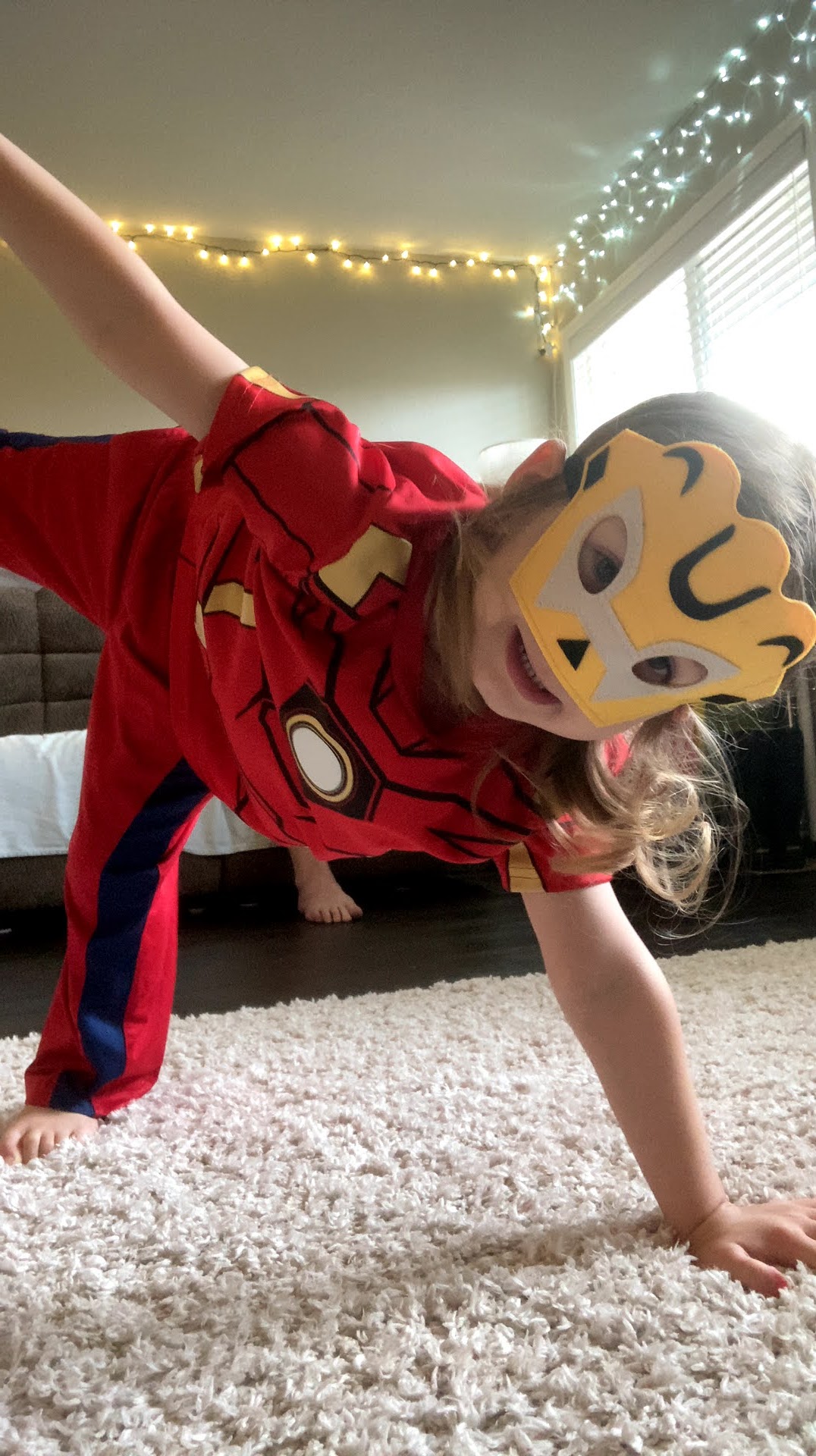
I loved seeing the excitement in his eyes when I’d learned the names of his Rescue Bot toys. He taught me about transformers, superheroes, construction equipment and more. The phone with my face on the screen became a stand-in for me. He placed “me” on the back of a toy racecar and squealed, “Hold on, Nonny!” Virtually, I zoomed around his home (seeing only the ceiling go by), went with him into hiding places, cuddled on the couch or simply sat on a shelf and watched while he transformed from vehicle mode to robot. I’ve even been allowed to accompany him in time out. In his room, under his bed or under a blanket tent, he shared with me his feelings (very self-aware), something I may not have gotten in person—especially when he was mad at the adults in his life. On the phone, far away, I became his safe buddy. In some ways, the intimacy that comes with remote communication changes the grandparent dynamic. Sometimes, I’m more playmate than disciplinarian. Yet, I can tell there are certain topics he shields from me that he tells his Mom. My status as grandparent is flexible. I initially tried to use the opportunity for educational flash cards and to play school and read books but typical boring grandma stuff wasn’t going to fly with the boy for long. He needed a playmate who understood his obsession with Bumble Bee the Transformer.

By the time he was five, he could spell and do complicated math. For a while, rather than FaceTime, we texted on his mother’s phone. He could put together complete sentences. He liked to surprise me by choosing the most popular intuitive word choice that popped up in the bar and see what sentences we could make. I responded by doing the same with my phone. In this way, I also learned about my daughter’s conversations with her friends, which was an interesting perk. He learned how to send me filtered pictures that looked like cartoons. I asked him how to do it and he texted me step by step directions how to use my iPhone to use emoji’s, photo filters and more. We started taking regular pictures around the house and then adding artistic drawings on them. For instance, a Santa Clause hat on a picture of my cat. Or, his drawing a white beard on his own face. His directions were superb, not like an impatient teenager who just whizzes through the steps for you without teaching anything. This kid is a natural born teacher.

The first time I masked up for a visit after vaccines, he kept reaching out to touch my face, “I can’t believe you’re really here!” he said.

He’s seven now, but still thousands of miles away. We still FaceTime. He calls almost daily. If even a few days go by without contact, I witness great strides in his intelligence and understanding. By virtue of his level of sophistication our games have become more elaborate.

He tells me he is “the director, the producer, the stage hand and one of the actors. Nonny, you are all the other actors,” he says with a laugh. And, director, he is. He has scripts in his head with elaborate costuming detail that we imagine. It is important to him that I have in my head exactly what he sees in his mind’s eye. The colors of a dragon, its eye color, wing span, special powers. The way his Werewolf character still has wolf ears and sometimes a tail when she is in human mode but also what color and how long her hair is and what she wears. Whether I am a black panther that can turn into a human or maybe a hyena or even a hamster, there is a script. If I ad-lib too much he cuts the scene, instructs me on his vision and then says “Action”.  We have named this game “Schizophrenic” because of all the personalities I have to take on. He snickers every time he tells me my next role. It’s part of his fun to shock me and more fun for him if I act shocked. I have been any number of animals, teachers, friends, transformers, mythical creatures. Whatever his imagination (or the latest video game, movie or television show) introduces, I become.

My favorite game is YouTube or Podcast. In the first, my boy demonstrates a skill he has learned and I am his audience. His introduction, ability to break down the steps, and his warnings what “not to try at home” are hilarious and spot on. In Podcast, he is the star of the show and I am the guest. We go back and forth with questions like an interview. With this game, even though we are playing characters, I learn how is day has been, the highlight of his week, who his new friend is, what he has been watching. It’s like a real conversation for me but because “talking is boring for kids” podcast makes it a game he will play.

“Google Black Princess Dragon,” he says. Or, “Look up images for the Tails character on the Sonic Movie”. I have done my research, let me tell you. This Nonny, in my own adult home with no children around may be caught watching “Sonic”, or “How to Train Your Dragon” or “Transformers”.  “Have you seen Spongebob?” he asks. “In this scene, your house looks like Sandy’s.”

In real life, I live in my family’s third generation farmhouse. I’ve found myself walking in my parents (and grandparents’) footsteps on many occasions. This year, my garden would make my father proud. Every time I can tomatoes or freeze corn I think of my mom. In some ways, I believed my grand-parenting days would be more traditional, more like theirs, more in person and hands on, passing on my love for the earth, gardening, flowers and nature walks. But children don’t stay near their birthplaces like they did in older generations. Loads of grandparents live long distances from their children and grandchildren. Though I think there is value in family groupings, these days, that way of life seems obsolete. Sometimes I lament that I don’t have the weekend sleepovers, the after school visits, but I do have some things other grandparents don’t. Our relationship is far from traditional but very special, even across the miles.

Adjusting my expectations, allowing my grandson’s natural understanding of technology to pull me along, maybe I’m not as obsolete as I feel. I resist technology on many fronts, but if it weren’t for FaceTime, I would be missing so much of his childhood. We would have figured this out sooner or later, but it seems the pandemic pushed us to learn how to keep in touch in this new way. A way that, to his generation, comes naturally. When swapping grandchild stories with my friends, though our hands on experiences are much different, our exhaustion levels are about the same. It’s hard work to be a panther who turns into a boy with a hyena for a brother, and school friends who are snakes, hamsters, dragons or werewolves, without eating one another! I don’t know many grandmothers who know this.

I have always been one to look for silver linings. There is a word spreading across social media for when you find a tiny piece of joy in the world. Glimmers. This boy, this brightly shining light, is one of my best glimmers.

Bad Date

This is an essay about a time in my life (almost 20 years ago now) of great personal, spiritual growth and transition. And the worst date of my life.

At forty-two and nearing the empty nest portion of my life, I decided to go back to school. During a critique of the first short story I wrote for class, my instructor, though encouraging, said, “I just don’t think you’ve found your voice yet.”  He was right, but not just about my writing. I had not asserted my voice in life. I cried all the way home, not because I couldn’t handle criticism but because of what his words said to me metaphorically. My attempted short story, instead of fiction, was nothing more than a true account told by an unreliable narrator, me. What I had believed was a bizarre but laughable scene disturbed the other (much younger) students. They didn’t like some of the characters, called one a jerk, thought one was emotionally abusive. This was news to me. In literature, the narrator is the speaker (in fiction, this is different than the author) who tells the story. If it is an unreliable narrator, the reader can see what is presented is not what it seems. In other words, the narrator doesn’t know what the reader can clearly see. If done well and on purpose, this is a good literary device. You can see how this might pose a problem for someone writing about their own life, passing it off as fiction. Thus, the unreliable narrator.

For the record, inexperienced writers often depict stories in the wrong light simply because they lack knowledge about the elements of literature. What is intended doesn’t always come across correctly. What seems like abuse, might not be if the writer unintentionally leaves certain facts out. I was definitely an inexperienced writer. I was also definitely an unreliable narrator to my own life. Writing was the vehicle that showed me the truth. 

 Just two years prior to taking the writing course, when I turned forty, I bragged to my childhood best friend that the milestone birthday did not faze me. I finally had life figured out. I was confident. I knew what I believed spiritually. My sense of self-worth was validated by my roles as mother and step-mother of two healthy, intelligent children and wife of a public politician. If depicted on a tarot card, I would have been the support beam beneath an ivory tower that was crumbling. Having seemingly conquered the world, I was about to embark once again on the Fool’s Journey. I’ve written volumes about this time period and coined the phrase, “Volcano of the Soul” to describe how it felt.

            A friend suggested I read The Artist’s Way, by Julia Cameron, a twelve-week course intended to help you get in touch with your creative side.  In the first weeks of the course it is suggested the reader take themselves on a date at least once a week for a minimum of two hours. The only rules are: what you do must be for you and you alone.  No one can go with you.  It is an attempt to let your creative side (inner child) come out to play without the peering eyes and expectations of onlookers, aka family. At this point every outing I had taken had someone else’s intentions behind it.  If I went shopping by myself it was to buy something for a member of my family. Even this was against the rules. I decided to give this date thing a shot.

At forty-two, having been married twenty-four years, I went on the worst date of my life.  Even worse than when I was fifteen and asked one of my brother’s best friends to escort me to a dance. I was a sophomore in high school.  He was a freshman in college. He was the only one of my brother’s friends who had been genuinely nice to me without the agenda of getting close to my hotter best friend. I had been in love with him for years and it took all the bravado I had to ask him out. He agreed and picked me up in the black mustang I had stalked all over town. He was the kind of guy who opened doors for his date! And also turned out to be the best dancer at the party. At the end of the evening, he walked me to my door but wasn’t interested in kissing me goodnight. He and his husband are very happy today.

            No, this date was even worse than when I was sixteen and the guy honked the horn in the driveway because he was thirty minutes late already and didn’t want to miss the previews of the movie we’d chosen.  He farted on the way to the movies and blamed it on me, then told me I “owed” him something for the price of the movie ticket and the gas (the car’s, not his) and stuck his tongue so far down my throat I thought I’d have to swallow a whole bottle of Listerine to get rid of the memory of him.

            I gave up on dating and married the next guy who asked me out. Well, it’s not exactly that simple but truth is like a rolling vein, every time I take a stab at it, it moves. Anyway, I’m not sure if my marriage was a mistake, because…karma and all, but take my advice and don’t get married until you know who you are. It saves everyone involved a lot of heartache.

As it turned out, having been married for decades and raising children did not make me any better at going on dates, even when I was by myself. I simply didn’t know what to do with myself. I’d never slept in a bed alone. I hadn’t been to the bathroom without interruption in over twenty years, not to mention a silent bath or a good book. How was I supposed to know what to do? I headed toward Lexington, Kentucky, the nearest real city in fifty miles of my rural hometown. Richmond was closer, but smaller and I was there all the time. Once I hit the interstate, it occurred to me how much I disliked trips to Lexington. The traffic was horrible and it took as long to get from one end of town to the other as it did to travel the whole fifty miles from home. I thought about which Lexington exit I might take and what I would find there, a shopping center, a mall, some restaurants. The only reason I ever went there was to buy my daughter’s clothes. I hated shopping and the book said I wasn’t allowed to buy for someone else on this trip, so why Lexington? I pulled over on the interstate to decide on a new destination. Nothing. Nada. Couldn’t think of a thing I wanted or needed to do except get away from the noise of the house and take myself on a date as instructed. I wasn’t hungry so no need for a restaurant. I didn’t need any clothes. I bought all mine at the Catholic Church basement sales because it didn’t yet feel okay to spend real money on myself. (Did someone say self-esteem issues😊) I sat on the northbound side of I-75, tears streaming, because I couldn’t even take myself on a stupid date.

I took the next exit and headed back toward Richmond. I drove around thinking of things I had once enjoyed doing and thought of Peddler’s Mall, a flea market opened daily and filled with booths of consigned items. Treasure hunting is what my husband and I did for pastime. I pulled in and walked around but it all looked like junk now, not treasures. It dawned on me how full of junk our house and lives were. Then, I realized it was my husband who loved this place, he who bought all the eclectic detritus that had become our abode. Once upon a time, his grandmother came to our house and when she walked in the door, she said, “Well, I see everything here but money.”  Another time, early in our relationship, a friend of my husband’s came in the house with someone who had never been there before. There was a dental stand in the living room we used as a planter, a full-sized stop light lit up for mood lighting in the corner and the dash board of a 1957 Chevy on the end table. There were bicycles hanging on every wall instead of photos or pictures. “Everything you see here is all Ralph,” the woman said. At first it hurt my feelings because I lived there too, but then I realized she was right. Nothing in our house said I lived there. I didn’t collect anything. I didn’t have a “taste” in furniture. I’d never even bought furniture. I used whatever was available, whatever he’d had before I got there. I lived in my husband’s house.

            In the back corner of Peddler’s Mall was a booth with nothing but books. I wandered in there and fumbled through the titles. In the Kentucky section were books by Wendell Berry and Janice Holt Giles. Having just been introduced to good literature through my class, I bought one of each. Reading had once only been an escape for me while I waited for my daughter to get out of dance practice. It was the only time of day I allowed myself the pleasure of reading because the waiting hour had already been built into my day as non-productive. I don’t know where I got the idea that reading was a waste of time. It is not! As a writer, I’ve learned that one must read more than they write as part of learning the craft. I took my books and went home.

            The next week, I drove straight to a used book store and sat at a table for my two-hour date, reading. After that I found other book stores and visited them each week on my “date.” In one of them was a poster on the door advertising belly dance lessons. I thought I might need some exercise, so why not? It was a two-hour lesson each week which filled my time slot. During that first session, other women dressed the part of a belly dancer. We’ve all seen on television what this looks like for a performance with all the jingles and sparkles. But for practice, this amounts to a long flowing skirt, any kind of stretchy top and lots of scarves. It’s fun to dress the part. If you really want to play, you can wrap scarves into your hair, add the hip scarf with the dangling discs and even wear a bindi, the beautiful forehead jewelry worn by Indian women. My hair was almost waist length so I could braid and wrap with beads as well. This really did fit the bill for letting out my creative inner child. (Halloween was one of my favorite holidays, after all). As soon as they got wind of what I was doing, both my daughter and my daughter-in-law wanted to join the class. It was great fun and I hated for them to miss out so it became a family thing, a woman thing I was reluctant but also happy to share. It was back to the drawing board to find a date for and by myself.

My search for enjoyable outings was a good step in learning about myself. I truly enjoyed the dance, the dress-up, the ritual. Belly dancing is an empowering act for a woman. I had previously thought of belly dancing as a seductive performance for men’s pleasure but it turned out for me to be a bonding feminist Goddess experience of sharing with other women. The seduction, for me, was to allow myself to fully engage in play. Our instructor taught a fusion style of dance, meaning that the moves were borrowed from different cultures. She said that historically, the ability to belly dance (it takes extreme fitness and tones every muscle in the body) was significant for readying oneself for childbirth. The slightly darker side of that tradition is that women danced for prospective mothers-in-law to prove their ability to carry on the family name and be chosen as a wife for their son. I have mixed emotions about this part of the tradition but I realize we borrowed this beautiful dance from a different culture and a different time. Still, it was a powerful dance performed by women, for women.

We began each belly dance class encircled, in a movement meditation which also served to stretch our muscles. The instructor asked a probing inward-looking question for each of us to consider. Each person had an opportunity to share their answer. I know they worried about my sanity and stability. It was a raw time, painful to go through, beautiful to look back on.

Because I had asked for personal growth, the Universe opened doors for me to walk through and learn. I was aligning with my true authentic self and all the events of my life seemed synchronized to that end. Tears were always just below the surface. At this time, my father-in-law was a board member for the Kentucky River Authority. He talked about the locks and dams and how the gates had been welded shut when water traffic had stopped. He checked the locks regularly by boat to see if they were holding, it was sometimes one of our family outings. I felt like nobody had been checking mine because the dam had broken loose and there was no stopping the floods that came without notice. Anything set me off. I believe it was grief for the part of me I’d given away so many years before.

            I decided I could use counseling. I looked in neighboring communities for the sake of anonymity and found a good therapist in Berea, a forty-five-minute drive across back country roads. I always liked Berea. The college there brings a concentration of creative endeavors and the downtown has a good vibe. I liked that I had no cell service on the drive so I would not be disturbed. I liked the way it felt to go to the coffee shop before my appointment, to sit among college students and hippies, and to the fair-trade store afterward. I loved everything in that store. Most of the women in my belly dance class lived in Berea and I usually saw a few friends on the downtown square. My counseling appointments became a new part of my date. They were arguably all about me, after all.

            I have written volumes of complicated pages about events that occurred in the decade of my life that began on my 42nd birthday and upturned everything I had ever known. In a simplified nutshell, it went something like this: I buried both my in-laws, two of my siblings and both of my parents, ended my 30-year marriage, my daughter moved 2500 miles away, I learned to live alone (in Berea and then my inherited family’s farm). I learned that no matter how much I loved being a mother, the role did not completely define me. I learned to take myself on dates. I acquired a Master’s degree. I met my people in the form of other writers. I learned that if I was going to collect anything, it would be books. I learned that I’d still rather buy used clothing than new, not because of self-esteem but because I hate waste. (There are so many good clothes in consignment stores.) I’d rather be in the woods than a mall. I learned new and deeper ways to listen, feel and to see God’s presence all around me. I found feathers, stones, and driftwood to decorate my house. And for a while, whenever I invited friends over to my home, every one of them said, “Wow, this looks just like you.”

Twenty years later, I am more settled and content. I know who I am but I know better than to think I’ve arrived. As a spiritual being having a human experience, I know I am not finished learning and hopefully not finished growing. In this third and final phase of my life’s work, I’m actually hoping for some of that crone wisdom. In the meantime, I again have too much junk in my house and plenty to do to keep me busy.

Recycling

I wrote this essay many years ago to have a laugh with and about my father. He liked this essay and bragged to his friends that I used him as a muse for my stories. One of his greatest attributes was being able to laugh at himself and tell his own embarrassing stories.

            When Dad had by-pass surgery, Mom’s company was all he wanted. He was like a child, scared to let Mom out of his sight. Having his tender heart manhandled did a real number on his psyche. The rest of us became pegs looking for a hole to fill. How to help him became how to help Mom while she was sitting beside Dad. On one of my visits, I chose to tackle the kitchen.

            I started by washing the dishes which included more cottage cheese containers and peanut butter jars than I care to remember. My parents could never stand to throw away perfectly good containers, with lids! Throughout my childhood, the dreaded empties lined up on the kitchen counter soaking in soapy water. I always hoped they got washed out before it was my turn at the dishes.

I was sure Mom had a real set of dishes, I’d seen them on birthdays and holidays, but they were hidden behind a multitude of Happy Meal cups, margarine tubs and other designs of reusable ingenuity picked up at the local grocery store or fast-food chain. The rest of the country may live in a throw-away society, but not my folks. They don’t throw anything away. With their grandchildren grown, I felt fairly certain Mom and Dad should be able to use the good stuff without breaking it so I took a few liberties with the cleanout. I imagined how happy Mom would be to find I’d made so much new space in her cabinets. Then, I opened the silverware drawer. I expected to see the complete set of table ware that we’d once collected from inside detergent boxes at A & P. I didn’t know I would have to hunt for it beneath the best KFC and Long John Silvers had to offer, separated by color and stuffed into reused plastic bread sacks wedged between the silverware tray and the side of the drawer, which barely closed.

             Being a preacher’s wife meant mom did not have to cook on Sundays. But that didn’t mean she had the day off. After church we visited shut-ins, sick and old, in their homes, in hospitals and nursing homes until supper. ALL of us. Sometimes, if Dad was lucky, a member of his congregation would invite us for a meal after church (saving him money), but, if we were lucky, they wouldn’t. Yes, the home cooked meals were fantastic, but fast food was a rare and festive occasion for us then and Long John Silver’s did not expect the “children to be seen and not heard”.

            Dad never failed to remind us to save our plastic forks, “You never know when you’ll want to go on a picnic.”  His words still resonate. We never questioned it. We lived in a perpetual state of hope for this thing we saw on television which included a red and white plaid table cloth laid out in the middle of some central park like place and a grand basket filled with fried chicken and deviled eggs, our friends frolicking in the background. There may even be a lake involved. The closest we got to a picnic was riding a wagon behind Dad’s tractor down to the riverbank on our farm to watch skiers skim the water on weekends. Mom probably packed sandwiches. Not a bad adventure but we didn’t need plastic forks for that. I wonder if plastic dinnerware is considered a collectible antique after twenty years, like cars? I could be rich!

            Dad was born in 1928, one of thirteen children.

            Recycling wasn’t even a word back then, it was survival. Dad’s skills in saving had been honed to perfection and carried out in our own family. I’m not knocking his frugality; it was a good lesson for me to learn. I still live within my means and re-use everything possible. It’s just that he and Mom kept everything, well past it’s time.

We enjoyed the treasure hunt of yard sales but no treasures were ever found at one of our own. Once my parents were finished with an item, there was no use left in it. Mom wondered why she couldn’t make any money at yard sales like other people did.

            This fork collection though! Mom had gone to the grocery, most likely because she needed out of the house for a breath while I was there with Dad. I felt sure she wouldn’t mind so I started pulling the massive collection from every nook and cranny in several kitchen drawers. Unfortunately, Dad’s reclining chair was positioned with a view to the corner of the kitchen where I began.

“Hey, what do you think you’re doing?” he yelled.

“I’m just cleaning up a bit, Dad.”

“You’re not throwing those away, are you?” I recognized his high-pitched agitation voice from my childhood. I turned to look at him.  

“I’m thinking about it, Dad. We’re all grown now, why would you need dozens and dozens of plasticware you never use?” I asked.

“You never know…” he began.

“When you’ll want to go on a picnic?” I completed his sentence. He knew he was being called out and I knew I’d overstepped my bounds. Here came that high pitched voice again.

“I have no intention for you to come in here while I’m down and go changing everything around. Does your mother know what you’re up to?”

I knew I was treading on fragile ground, here. I didn’t want to cause him more stress.  “Dad, how about this?” I said, “I’ll box them up and label them and you can keep them in storage. But let’s at least clean out these kitchen drawers, can we? I’ll bet Mom would appreciate that. He agreed, albeit reluctantly. I found a shoe box (of course I found a shoe box, they never got thrown away either) and started stuffing all the white forks and knives and spoons into it, realizing I was going to need a second box for the black set.

            A couple of months passed with no mention of the ‘cleaning incident’.  It was late August and time for our family reunion, which Dad always organized. With his recent open heart surgery, they were going to need some help. Mom phoned to ask what I would bring and let it slip that Dad had volunteered to supply utensils. We both laughed. I should have been glad he’d decided to finally use the things. Or, re-use them as the case may be. I know in my head that plastic can be washed, but somehow the idea of these used plastic forks just bothered me. Who knows, the person I might be eating after could be me—some twenty-five years earlier. It just didn’t seem right.

            Dad, one of thirteen children, gifted me with forty-eight first cousins. Reunion Day arrived and so did our relatives, like a gaggle of geese migrating south. Some in fancy cars as if to say we too should have followed them north for better jobs and better lives. I had no intention of telling them about the forks. I actually thought it was a little bit funny. I came, of course, equipped with my own.

            Standing in line for food I noticed my cousin Bobby, a local, with a stainless-steel fork sticking out of his back pocket. His mother and my Dad were siblings. I slid in the food line behind him. “I see that,” I whispered, tapping on the fork. 

            He pulled me aside as if we were about to become traitors to our country.  “Listen,” he said, “my mom saves her used plastic forks and brings them to these reunions. I’d be careful if I were you, which one you choose.”

            “It’s worse than you think,” I said, laughing, “so does my dad.”  I pulled out my fork to show him and we both broke out laughing. He raised an eyebrow and we looked around the room at all those unsuspecting cousins.

            “You mean all the plastic ware on that table have been used already?” he said.

            “Yep. Should we tell anybody?”

            “No way. It’s too late anyway.” Then, we saw Kim, another local, her mother another sister to the two culprits. The three of us had become pretty close as cousins go. We hated to leave her out so we approached as if we had unearthed a murderous family skeleton.

            “Kim,” I began, “Bobby and I want to tell you a secret.”

            “What’s that?” she grinned.

            “My dad and his mom save all their used plastic forks and bring them to this reunion. We brought our own!” We each pulled our stainless-steel forks out of our pockets.

            “Why do you think I’m carrying my own soda can?” Kim said, “My mom brings the cups.”

Holy Mystery-I See Dead People

Donna M. Crow

At a writing workshop, I was given this prompt:

Write about someone, living or dead, who you would like to have back in your life.

I know this sounds strange but most of the people from my life who have died, are still in my life. That’s not to say I don’t miss going to lunch with Mom or picking up a telephone to ask Dad a question. I miss singing with Sister Alice Rohe and hearing our voices harmonize. For a while, when someone I love dies, I catch myself reaching for the phone to tell them something funny I know they’d appreciate. It takes a while to adjust the reflexes.  It was a real wakeup call after my parents died to realize there was no-one to whom I should report my whereabouts or trip itinerary. I felt untethered, somehow. No matter how old you are when your parents die there is a sense of having been orphaned. That being said, I am grateful to say that I see and feel the love from most of my loved ones on a regular basis.

I know I’m not alone in this but I don’t personally know any other people besides myself who can say (or will admit) they dream of dead people almost every night. I don’t remember when it started. People I know. People I don’t. People I’ve only met a couple of times before they died. My ancestors. Grandparents who were dead before I was born, aunts and uncles who have since passed. My in-laws. And now that I’ve lost over half of my origin family, they too appear on a regular basis. Mom more than Dad. Both appear more often than my two deceased siblings. But each has their purpose in visiting. Some speak. Some don’t. Sometimes it’s a great reunion with hugs and “I’m so glad to see you again.” Most of the time, they don’t touch me physically and our conversation is telepathic. In these dreams, I am not re-living past experience. I am not ruminating over what is lost. I always know I’m talking to a dead person. They reveal hidden truths in my subconscious that will help me in my waking life. And most of the time I wake up grateful.

Some come with messages for the living. Some come to give me support. Some want help to be released from earth’s hold. Some have been patiently waiting for me to let go of them and they come to say goodbye. They reassure me that I’m on the right track, sit with me through a storm or show me where I need to adjust my thinking. Susie wanted me to help her son. Jim thanked me for friendship and prayers. Bill simply smiled and walked beside me for a minute because we’d talked about what it might be like over there and he wanted to let me know he was okay. My father-in-law was afraid of where he might be headed and asked me to help him stay here. My mother-in-law finally told me what she’d been wanting and waiting to say for years about my marriage to her son, my sister brought me a gift as she said goodbye, my sister-in-law apologized, my friend Sister Alice has continued to be a spirit guide who appears as necessary to shore me up. My brother shows up with a grin, no words, and plays pranks. My mother is a guardian for me, my daughter and grandson. She visits the most. My dad watched for a while, but it felt more like he was waiting until I could go with him, because he was afraid to cross over. Now he only appears occasionally as a nod of approval and support, sometimes with a word of wisdom.

My paternal grandmother whom I never met visited only once, with a vision of how her life had been. A life full of babies, hot stoves and hard work. She was a soured woman, hipping a baby while turning fried chicken in a pan. All my uncles and aunts and cousins swarmed in and out of her kitchen. She handed me the baby and I knew it was me. “Here, this is yours. Nobody’s gonna take care of it but you,” she said. A recurring message from the matriarchal women of my ancestry.

My maternal grandmother has been with me since childhood.

There are so many dead people who are prevalent for me that it is hard to choose who I would like more time with on this earth. However, since she’s been with me the longest, I choose, for this prompt, my maternal grandmother, Mayme Powell Broaddus who died when I was six years old. She was my only living grandparent at the time I was born. Looking back, I believe her absence created the greatest void. I longed for grandparents and because I had none, was drawn to old people. Our elderly neighbor, Mr. Hall who could make something out of nothing, who made his own sundial out of a hole drilled into his patio and filled with silver paint, who recycled window screens and coat hangers into fly swatters. He cut a path through the field from his house to ours so us kids could visit him without getting on the highway. We went to see him every day, took him supper and watched out for him like he was family. The old lady, Annie Masters, who went to my dad’s church, called me granny, taught me how to properly scrape corn off the cob for freezing and once I was a teenager admonished me not to accept secondhand scraps when it came to men. “Get a fresh one, first time around the block,” she said, “not been married, no kids.” I loved being around old people. They had the kind of wisdom I needed, even though I didn’t know it yet and rarely took their advice. My first husband was 14 years older than me and provided me a built-in son. I’m not saying I have regrets. Karmically, I was where I was supposed to be. Practically, Annie saw it coming and told me so.

I’m not sure what kind of grandmother Mayme would have been had I known her my whole life. What I remember of her is limited. Braiding my hair before I went to Vacation Bible School, letting me sleep in the bed with her when I got scared, on the only occasion I remember spending the night. But I know what kind of grandmother she has been to me, even deceased. I went to her in my head and heart when I was disappointed in something my mother had done. I asked her to intercede for me when Mom was mad or hurt. I asked her what made Mom act in certain ways. When Mom avoided or denied her true feelings, I knew Granny would tell me the truth. I dreamed her. I conjured her. I felt her climbing into bed and wrapping her arms around me to comfort me when I felt alone in the world. When I had existential questions about my parents’ fundamental values, it was my internal grandmother who refused to fall victim to strict religious views. She was flexible, understanding, loving. She loved to laugh and to travel and have the kind of fun sometimes unbecoming of an older woman during the time in which she was alive. She never let me down.


I always admired that she kept the engagement ring of her first true love even though he was not the man she married. She wore it whenever she was mad at my grandfather. The idea of it upset my father the way it might have upset my grandfather, as a betrayal to marital commitment, so it lived in Mom’s jewelry box. Male insecurity. I coveted that ring, and eventually talked my mother out of it. To me, it stood for the kind of independence I needed in my life. It stood for confidence, defiance. It stood for not letting a man own you. It stood for love of self, something I could not fully muster in early relationships. My husband at that time, knowing the ring’s history, hinted at the same kind of insecurity whenever I wore the ring. Wondered what kind of statement I was making. The gold band is worn thin and should be replenished so I don’t wear it often now for fear of breaking it, but whenever I need to feel close to my grandmother, I get it out, hold it and sometimes put it on for a day. It is as if the ring holds the power of alchemy, the ability to give me strength. I have a wooden cross necklace on a leather string given to me by my friend Sister Alice Rohe on her deathbed. “You’ve got some big decisions to make,” she said, “and I want to be there with you when you do.”  After she died, I didn’t take the necklace off for 3 years. Now, like my grandmother’s ring, I wear the necklace when I need to feel her guidance in my decision making.

Symbols, like rituals, give us comfort and hold whatever power we give them. I know all true power comes from God. And, I thank God daily for allowing me to experience these comforting dreams and symbols. What a grand Master of design!


Granny loved her flowers and there are pictures of her holding various bouquets from her own yard. Mayme’s Flowers. Mom transplanted many of those perennials to her yard which are now in mine. After Granny died Mom visited her grave with those bouquets every year. I am not so diligent. I believe both Granny and Mom are in my yard tending to my flowers so I don’t have to go to the cemetery to see either of them. They are with me. There is another picture of my grandmother on one of her trips to Florida, after my grandfather passed away. It seemed to me, if pictures tell any part of the truth, that she only began living after he was gone, and her children were grown. In this picture, she is sitting atop a bull, meant as a photo op in some tourist town. She is wearing a (cowboy?) hat and waving a pistol like she might be in a rodeo. To me, this picture says it all. Or at least what I want to believe about the free-spirited soul she longed to be. I know it is only a moment in time and not a true depiction of the whole woman. Are photo albums any more than a chronicle of false memories? We set up photos to seem like we’re having the best life when perhaps the children are mad or crying or the parents are fighting. Yet, for a moment, everyone stops and smiles for the camera, or pretends to be in a rodeo. These are the symbols we create to live by, to pass on to the next generation. A false history. Still, I believe I can see her true spirit in this photo like in the one with the flowers. Her spirit is bright and she is one of the many lights that guide my way through the dark night.

I was born into a fundamental doctrine with lots of rules and fear and I have wrestled with the difference between what I know and feel in my heart and what I was taught through traditional religion. I ask God these questions directly and this week as I went to sleep, I asked again, “Am I on the right road? Will you please help me understand? Give me clarity?” I dreamed my own father—a rare visitor these days—came and told me that all roads lead to the same mountain top and that once I reached the top, I could look over the whole range of mountains and see where all were connected as one. Was that my dad? Or did God/Goddess send me a message through the likeness of the one person who instilled so much fear so I could heal an old wound and deepen my trust and faith? Whatever Holy Mystery this is, I’ll take it.   

Aliens

Beneath the large Black Gum Tree in our front yard, the one whose roots made occasional appearances in the dirt of our Hot Wheels racetracks, my brother David twisted a tire swing around and around until my feet were high off the ground. While he twisted, he whispered to me that the two of us may not belong in this family. He came up with this theory that our real parents had been abducted by aliens because we seemed so different from everyone else in our household. I was inclined to believe him. If it had been my story, told today, I may lean toward he and I being the aliens dropped into this unsuspecting family, because we were two of a kind in a foreign land. 

We’d never been told that Mom had been married before, prior to meeting our father. Dad had been helping her raise the two black haired/brown eyed children, whose own father was M.I.A., a few years before David and I came along with our fair-haired English/Irish complexions. By the time I was born, our oldest sister Barbara was almost 12, brother Butch had just turned ten. David had only been scoping out the planet a short while and already had made a few discoveries he couldn’t wait to share, like different rules for different children or how some kids have extra sets of grandparents which translated to extra Christmas presents. I arrived two days after his third birthday and I like to believe he considered me a gift.

Dad held him up in the nursery window where I and some of my future classmates were displayed and asked him which baby he wanted. Born a few weeks late and weighing in at 10 pounds and 21 inches, I was born tall and old. David was in bad need of a compadre and I looked like I was off to a good running start. Even the doctor claimed he’d delivered a three-month old child!

“That big one,” David pointed. Out of a half dozen babies, he picked me!

“Okay, son,” Dad said. “I’ll have them wrap her up, so we can take her home.” For years, David believed it. He liked to remind me that he was the one who sprung me from the hospital and that he could also send me back. (I have since checked the roster for kids who would have been in that window at the same time, and I can say Thank You Brother D for not sending me home with any of their families. Shoo-Weee! Even if ours were abducted by aliens!) For his part, he was happy to have me deflect Barbara’s attention away from dressing him up like a girl.

Barbara was the age most girls are when they begin to pay attention to real babies, too old for dolls, too young for her own children. With two brothers she was primed and ready for another girl. In some ways it seemed I half-belonged to her. Whenever Mom had asked her help with David, she had used him as her dress up doll, putting him in a dress and painting round red circles on his cheeks, a bow in his hair. I was real, better than make believe, however short lived it was. She was over babies and children by the time our youngest addition, Angela, was born four years after me.

With Angela’s arrival we were a family of seven in a five-room house. We tripped over each other and shared every material thing. Besides clothing, sometimes even our thoughts were handed down. When it came to sleeping arrangements, we were divvied up along gender lines in small alcoves on opposite sides of the living room. Until I was six years old, I slept with our half-sister Barbara, while David was sequestered on the other side of the house in some arrangement which included a half-bed, a couch, and our half-brother, Butch. Angela, the baby, slept in a crib next to our parents in the only room with closing doors. 

The house was a 4-square. Every room had two doorways so that you could leave one room and enter another, then another and another until you returned to where you were originally. As children, we used this unending circle within the square to chase each other. On one corner of the square, a bathroom had been added where none existed before. On the opposite corner, a porch had been closed in for extra bed space.  

It was no secret Barbara wasn’t fond of children. Most of the time, David and I had the impression we were merely “tolerated” by both our older siblings. Barbara detested having any of our friends or younger cousins around. She complained and usually left the house before they arrived. Her bonding as a mother figure was strictly limited to me, and viable only at night when everyone else was asleep. She rarely had anything to do with me during the day and nothing for Angela.

Butch was a prankster. He liked to pick on his sisters, play ball, laugh and hang out with friends. Oh, and listen to oldies music on a stereo we were forbidden to touch. He was gone a lot. I snuck in his room (the boxed in porch area) and snooped and touched all the things while he was away so what I knew about him came from my observations more than actual interactions, until I was older. 

Although I shared a bed with Barbara, you could hardly call ours a bedroom. It was more like a glorified hallway on the way to the only bathroom in the house so that everyone had to walk right past our bed day or night. This invasion into her privacy, irritated the teenager who seemed to me had already grown up. Any privacy I would find in that household came from hiding behind a toy barrel in a very small shared closet, pretending it was my own room. I hid there for hours until someone realized I was missing and came looking for me. My late-night bonding with Barbara included her angelic voice singing my favorite songs and lightly running her fingers up and down my arms to relax me into slumber, a technique learned from our mother. She sometimes shared secrets with me which made me feel special. Sleeping in the bed with Barbara created a symbiotic emotional bond which tethered us until her death in 2013.

From the beginning, I knew too much for my own good without the words to understand anything at all. I know now I was soaking in the energy from those I loved. As an empath, I was sensitive and thoughtful and easily worried. David lightened my load by being responsibly caring and funny as hell. I could pretty much count on him to say what was on his mind. My vivid imagination happened only while I was asleep. During the day, I carried the burdens of my well-meaning and good parents’ unspoken and emphatically denied emotions and because they denied the truth, I came to believe I could not trust my own intuition–or my dreams (which I now know were trying to clue me in.) I became a lifelong seeker of truth without always believing it when I saw it. This was exhausting work and tamped down any creative or imaginative endeavors.

At the time of David’s tire twisting alien explanation, the one and only living grandparent that we all shared had recently died, leaving Mom in grief. Barbara had moved to college which in itself was an adjustment in sleeping arrangements if nothing else. Especially for me, losing my night-time security blanket. Further, Barbara had become a girl gone wild, lending to Mom’s despair and our parents were beside themselves with what to do about her. Mom cried all the time. It was 1968. Barbara was diving headlong into the hippy scene, free love, drinking, pot smoking, and mixed-race dating which led to a mixed-race marriage, which led to dropping out of college, which led to racial discussions, all topics that were not allowed in our household. Barbara was blazing a trail on which we would all be singed.

Butch, for me, was the stereotypical older brother who picked at me and chased me into the bathroom with his friend’s boa constrictor wrapped around his neck. But he was Barbara’s younger brother—Irish twins—only eighteen months between them yet they had never been close. Unlike the easy camaraderie between David and me, they were separate satellites orbiting our familial habitat, with occasional thunderous clashes. During our alien invasion period, words were spoken between them that would never be taken back. Yet, none of this was spoken out loud where children were supposed to hear it. What we overheard by accident must be surmised on our own and through our own lens, then added to the palpable tension in the room. Of course these people were abducted by aliens!

Mom was trying to wean me to sleep alone but I was having none of it. I was prone to nightmares and when I woke, I yelled for what seemed like hours for Mom to come to my bedside. In reality it might have taken a whole 3-5 minutes for her to make her soothing appearance and shush me from waking the whole house. She had to cover my windows with sheets and load my bed with stuffed animals for protection. I had also taken to sleep-walking, and went straight for the door, apparently trying to escape while the rest of the house slept. If I coaxed Mom to lie down beside me, I held her tight so I’d know if she tried to move. Poor Mom. With a two year old in tow, I doubt she ever got much sleep. Soon, she placed the backs of chairs against my bed so she would hear if I got out of bed. Instead of lying beside me when I called, she sat in one of the chairs so she wouldn’t get pinned down, still tracing her fingers across my back and arms until I drifted off.  A couple of times, David was dispatched to sleep in my room, probably to give Mom a break and before long my little sister Angela became my roommate and protege, thus shifting my role from little sister lost to big sister mentor. Angela was born into changing times. She and I shared quarters for the rest of our years in that house together but unfortunately, I would never be as good to her as David was to me.  

Those early nights with David made for good black op planning sessions. We utilized our best spy techniques, learned from The Man from U.N.C.L.E. and pledged to watch, listen, learn and report back any alien activity. David was a keen observer and where I took everything to heart, he saw absurdity and was able to turn any situation into a great story or cartoon drawing, getting to the heart of the matter in a much healthier way than my rumination. We made a good team. I was his greatest fan and best (aka captive) audience. He made the jokes and I laughed.

I was the Robin to his Batman, the Tonto to his Lone Ranger. We were shoulder companions, forging through our world like superheroes with towels pinned to our shoulders, searching for clues. We fought invisible foes, pretending to be tied down on a conveyor belt, inching toward the doom of a sawblade. We’d borrowed this scenario from a real episode of Batman and Robin. To save ourselves, we used what we had on us, shoes. We took turns throwing a shoe toward the pre-designated shut off lever that would stop the saw and the conveyor belt. Our mark was one particular knob on a dresser drawer. If we missed the mark, we inched further toward the saw!

We founded a neighborhood club called The Eagle Eye Investigators. When the neighbors got involved, we sometimes chose sides, boys against girls and became each other’s temporary enemies but if things got too rough, I knew David always had my back. By the end it was always us against them. As big brothers go, he was the best, always including me in the fun and never outgrowing my presence or trying to get away from me when his friends were around. Except for when the aliens landed, we had an idealic childhood.

Somewhere along the line, I changed the narrative of the alien invasion to my being adopted. I felt things that I could never explain or put into words and had nobody to tell if I did. Sometimes I thought I must be crazy. Like a good investigator, I gathered my clues. They are as follows:

  1. I was in the kitchen looking through the junk drawer and found a box of wooden matches and a candle. I loved the rough scratchy vibration of striking a match and the blue/yellow flame that followed with the sound of gasping breath. I lit the candle. Then, I took other matches and held them to the flame to watch the spontaneous burst. Mom came in and frantically took them away from me saying, “My children never play with matches!” Emphasis on MY!  ‘Well,’ I thought, ‘I must not be your child because clearly, I’m playing with matches.’
  2. I questioned everything. I needed to know the why of things. Against the unspoken family rules, I wanted to know why Barbara and Butch had different last names. I wanted to know why there were different rules for different children. Why Barbara’s black husband wasn’t allowed to come to our house and why couldn’t we go visit them? I must have struck a nerve. Mom said, “You say things to me none of my other children would ever say,” then she cried, which was all it took to make me feel ashamed for ever having spoken my thoughts. I internalized a gasp of separation between us and it was all the proof I needed that I must not belong here!

With all my questioning, I did get some answers, stories about Mom’s earlier life that nobody else got. Even after we were grown David did not know the name of Mom’s other husband. I learned what a step-father was and heard words like alcoholic, abuse. While I was gathering fodder for future memoirs, David was busy making up stories of his own.

I eventually found proof enough of my birth to this family in the form of a baby spoon with my name etched on it. It was wrapped in a letter from IBM where Dad worked, congratulating him on the baby girl. I had been snooping through a portable file box left unlocked in the bottom of Dad’s closet. There I was, Donna Marie, though the baby spoon didn’t look like it had ever been used…hmmm. Even if David did pick the wrong baby, I decided to be glad he chose me and that we were in this adventure together.

About a year before both our parents died, Dad found a newspaper clipping with the names of all the babies born in the local hospital during my birth week listed with who their parents were. He gave it to me, “If you’re still looking for proof,” he said.

These days all I need for proof who my parents were is to look in the mirror.

Rollin’, 2008

(This essay was written in 2008 under the title, “Balls”. At the time, my life was taking a major turn. I was still married, although barely.)

Thanks to the Kentucky River Sweep, an initiative where volunteers in a parade of boats clean the river, our water and its banks contain less trash than they have in years.  My (now ex-) husband and I both grew up on the Kentucky River; him, a water dog and me, a bank dweller.  My parents’ farm borders the river and though they tried their best to keep me out of it, I spent hours on the bank fishing and watching boats go by. His parents owned boat after boat, even living on one for a while. Between the two of us, we have seen almost everything floating in that pool from bleach bottles to cow carcasses and shot most of it with our Daisy Red Ryders. Until a concerted effort was made to clean the unnatural floating debris left by careless polluters, one particular phenomenon escaped us both. That is, the great number of balls that end up there; basketballs, soccer balls, volley balls, kickballs. Easily a natural migration of gravity, or is it something more.  

            On a recent trip between locks and dams, a twenty-mile journey in our 1969 Lonestar Runabout, we spotted at least six different balls. There were virtually no other foreign objects.  So, we figured, with people being more careful, the balls must be getting there on their own. If it is round and filled with air, it eventually makes its way to the river. We were surprised we’d never noticed before. I also wonder if maybe this is new, a result of our throw away mentality.  When I was a kid, a ball, even deflated, held promise of future play. We never threw anything away, using it far beyond its natural life and then holding on to it just in case. What does it say about us today that we allow our kids to so easily discard these loyal playmates, leaving them to fend for themselves.

I love the river. This natural waterway snakes a path in and out of hollows and past people’s homes, gathering knowledge and strength from its mountain origins, never making excuses for humble beginnings. Every drop of water as important as the next, it eventually spills its wisdom into the great fountain that is its destiny. Along the way, it watches the life and death of farms and children as well as corn, cows and marijuana. Towns and Cities gather at its banks as the gentle lapping of water whispers the secrets of its people. Trees line the narrow banks of the Kentucky like arms welcoming a child come home and together with the sun provide a strobe-like prism across our faces transporting us from our daily worries. And, this little piece of heaven is as close as our next breath or our next drink of water. No wonder the balls want to go there. They are drawn, like us, to a better place. Who could blame them?

I thought about the lives these balls had witnessed and the children they had entertained.  Perhaps, even while being loved, they were taken for granted or sometimes abused. No matter how good the intention, a Chuck Taylor to the gut is never easy to take. I have to say, as a mother in the hollows of an empty nest, I know how they feel. Like a helium balloon cut loose after the party, they are no longer needed. They have entered a new phase of their existence. The purpose they served for so many years now finished, they must re-define themselves, find meaning in their last days. I have seen them, left in the yard, un-noticed, deflated, until one day, I imagine they hear the call of a faint song on a distant breeze, “Brothers and Sisters, come on down, come to the river to pray.”  A spa for old balls to soak, carefree on endless days. With no pressure to hold breath against hard concrete or bony fists, the tired, half inflated sphere allows the warmth of the sun to expand its possibilities, breathe in new life.  It waits for the earth to move, a wind or maybe a flood to begin this journey of patience and gravity.  Like aging, only a slow-motion camera could recognize their gradual yet deliberate migration southward.The lesson is not lost on me. We all need patience and perseverance to get where we’re going.

Driving across the river on a one lane bridge, following the railroad track up Miller’s Creek Road, I saw two more balls well on their way. One, a basketball, had made it all the way to the road but landed in the ditch. I wondered how long it would take before a rain would come heavy enough to get it out of that predicament. I pictured an over-loaded logging truck unable to brake on a wet road just as the ball started across. I almost stopped like I do when I see a turtle in the road. I thought tossing the ball over the hill would take months off its journey and ensure a safe passage, but then I saw a kickball down by the railroad tracks waiting for the next coal train to rattle the ground and I realized the path is never safe. There are dangers everywhere. With only six balls in a twenty-mile span, it is clear only the strongest survive. It’s the natural order of things and just because I noticed it, doesn’t mean I can change the outcome. Maybe, no matter how much help they receive, the ultimate responsibility is theirs to stay focused on the goal and take their chances with fate.  It takes guts…or balls to keep rolling along knowing they may not make it. Maybe even inanimate objects know it’s the journey that matters most. Maybe the obstacles they overcome make the destination even greater and the memories, stories they can tell the next generation. Maybe this story has little to do with abandoned soccer balls.

With the passing of my father-in-law, I helped sort through his life’s remains. The things left behind do tell stories, some are hard to listen to while others bring a chuckle. Packrats that we are, children of parents who lived through the first depression, parents of children who are about to experience one for the first time, the need to scrimp and save may come back into vogue. We tried to find a home for any good item we didn’t want, but even with conscious minds, there are some things that never should’ve been saved in the first place.  When the garbage men came to pick up some thirty-odd contractor bags full of trash there was still a basketball on the shelf in the garage, older than our grown children, breathless and bounce-less. I couldn’t throw it away. One of the men said, “What you gonna do with that basketball?”

“It’s yours if you want it,” I said, happy to find a willful home.

“I collect old balls. Pick’em up every chance I get. Sometimes we see them in the ditch,” the garbage man said. “I always stop.” 

 “What do you do with them?” I felt hopeful for one last ditch effort to give these balls another chance.

“We have an awful problem with dogs chasing the truck, but those balls take care of it,” he said.

“What do you mean? You throw it at them?”

“Naw, I’ll show you,” he said as he continued to load our discards. I hadn’t noticed when he’d wedged the basketball between the tandem tires on the back right side and hollered at his driver to pull up. “Hold your ears,” he said. It blew like a stick of dynamite. He straightened his back proud and waited for our praise of his genius. “Stops dogs in their tracks.”

 Clearly, I’ve given this way too much thought but I caught myself feeling sorry for the ball. It hadn’t played for years, but now it would never even make it to the river. Then, I remembered something my son told me while we were visiting his grandmother in the nursing home.

            “You don’t ever have to worry about going to a place like this.  I’m not gonna let it happen,” he said.

            “Are you going to take care of me?” I asked, surprised at his concern.

            “Naw,” he said. When it gets to that point, I’ll just shoot you in the head.” 

“Thanks son, that makes me feel so much better.”

All kidding aside, I know from experience there are a lot worse things than death. So, I’ll continue to notice the balls in odd places and wish them well and think about them as I wander along and hope that wherever my journey ends, the stories of how I got there will be good and the view as beautiful as an autumn day on the Kentucky River.