It’s mid-April. The June bugs have already emerged, colliding into their own reflections in our backdoor glass, beneath the porch light. Our dogs, Willow and Rosie jump toward the glass door and beg outside for a tasty bedtime snack. Rosie, the senior lab mix, hobbles on bad hips, picks her treats off the ground. Willow, the German shepherd, captures them in flight, chomps her teeth together so hard they sound like poppers. All year, the two dogs have combed the yard for the scent of these beetles in grub form. Nose to the ground, sudden onset digging, yum…protein snack. At least now the digging has stopped. The dogs can supplement their diet and keep the porch beetle free.
Every night around 9:30 p.m. as if an alarm has sounded, Rosie grunts, pushes herself up from her cushioned bed in the living room and stands before me, quietly at the couch. No matter how stiff her joints are, the desire for crunchy beetles provides the incentive for her to move. If I am distracted or slow to respond, Willow, the younger, larger and more assertive sister, also stands, comes over and nudges her nose against my leg acting as Rosie’s voice, her spokesperson. Rosie is demure.
Like most siblings, Willow irritates her older, invalid sister, prods her to play when she doesn’t feel like it, pushes her out of the way, steps on her, rolls her trying to assert dominance. But Willow is not brave, like Rosie. She is big talk but defers to Rosie’s wisdom and guidance whether to venture out of the yard. Willow barks at deer but will only chase if they run. They don’t. They know we pose no real threat. Willow backs down, cowers to the porch. For all her revelry, she won’t even go to the bathroom alone.
Willow continues head-butting my leg until I get up and take the two of them to the playground. By playground, I mean the security light in the front yard where beetles and moths dance in the light. I could open the door and let Rosie out by herself, but Willow looks at me until I escort her as well. The light is there for my security, but I realize it is an attractive nuisance for the poor beetles and moths. They only want to party, but Mockingbirds and Jays lay in wait for a bedtime snack of their own.
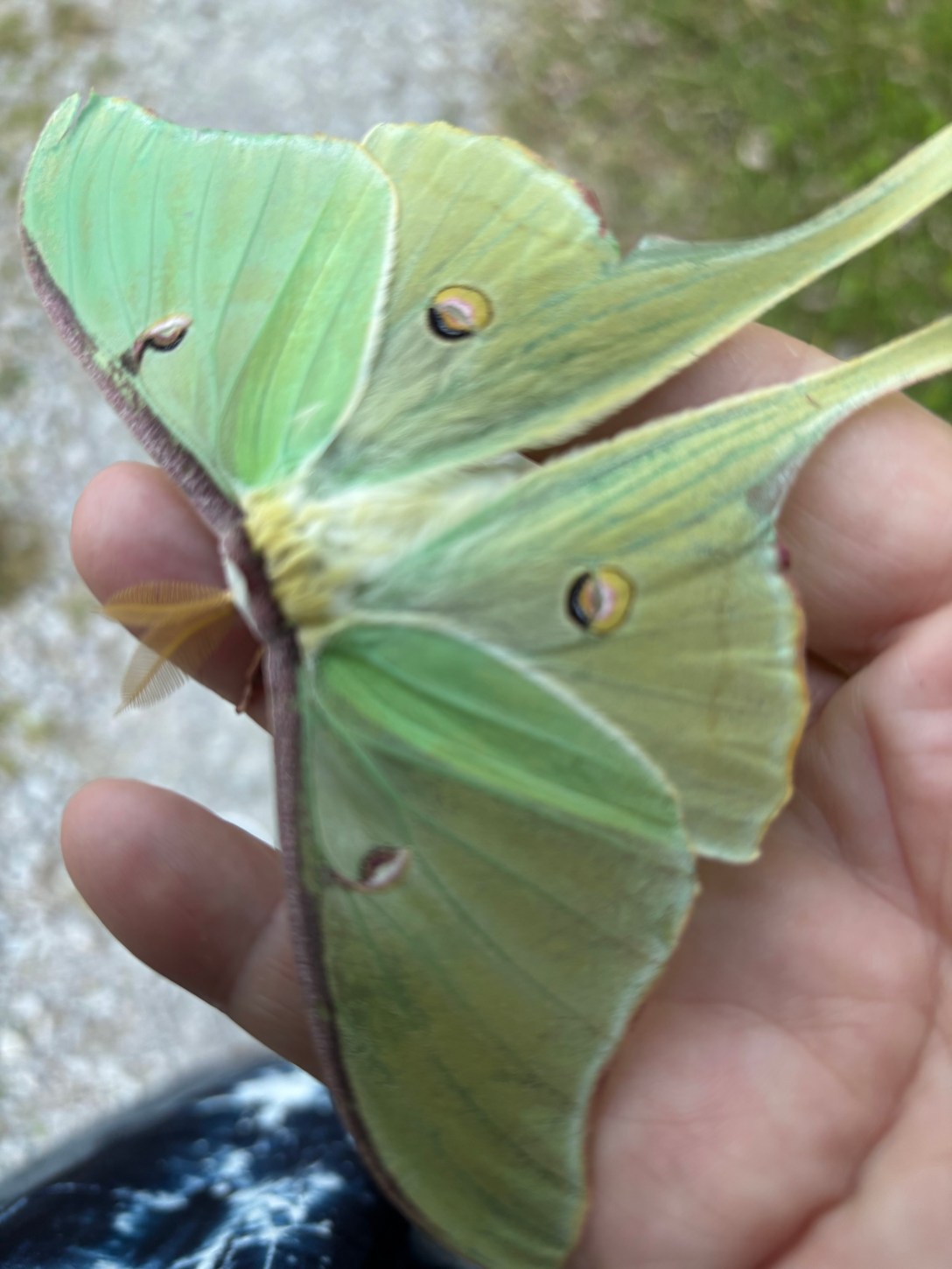
Each morning’s walk reveals the remnants from rambunctious nights. Wing parts, scatter the ground. Today, I find a Luna moth splayed across the gravel drive as if she’s had too much to drink. Her nearly translucent, palm sized, pale green wings are the color of fresh spring leaves. She’s still alive, all parts intact, but worn out from last night’s adventures. Dancing with friends, probably a little one-on-one action, dodging the mockingbird’s feeding frenzy, she survived the soiree. I lift her up. She doesn’t resist. I move her to the crook of a tree to sleep off her stupor. If she is lucky enough to live out another day, she will be ready to party again tonight. Luna moths have no mouth parts. Their only job is to find a mate, lay their eggs, die all within a few days of emerging from the cocoon. For them it’s all about the next generation. Such a short lifespan but oh, so beautiful.
A few days ago, it was a Giant Silk Moth instead of Luna. The Giant Silk Moth’s wings are brown and look like a dried leaf or a piece of wood with two eyes on it. Both of these moths look like other items in nature, a survival tool. These are two of the largest moths in North America. They have the same agenda, same lifespan. It is a gorgeous miracle that I live where I can witness their beautiful short lives.
I sometimes teach a class for senior citizens. This week I asked the small group of participants if they had ever seen a Luna Moth. None of them had and only one of them knew what it was. I’ve asked nature questions before to different groups of various ages and am always amazed how little attention people pay to their natural surroundings.
There are days when I question my choice to live off the beaten path, away from commercial conveniences. Yet, I always come back to this: Who needs to live in a city with all this exciting activity? Even surrounded by people–especially surrounded by people–I would be sad and lonely without these living companions. If the small percentage of people who cause the largest percentage of problems in our world today were nature lovers, we’d all have better lives.


Beautiful essay. Love the visual personalities of the dogs, bugs and the lovely moths living and partying hard on borrowed time. Your last line says it all.
LikeLike
Beautiful essay. Love the visual personalities of the dogs, bugs and the lovely moths, living and partying hard on borrowed time. Your last line says it all.
(I thought I was leaving this comment on your site but when I submitted it disappeared … )
Enjoyed it!
LikeLike
Thank you!
LikeLike