Turtle the Chimney “Sweep”

On Monday as I was leaving the office I found, at the bottom of the steps outside our back door, a mother and her teenage daughter mulling over what to do about an injured bird. As our steps lead almost directly to the street, the bird had possibly been hit by a car. It was stunned with one wing oddly askew like it might be broken. I stopped to assess the damage. It was as if we all knew, the mother, the daughter, me and maybe even the bird that I was the one taking it home.

The mother and daughter wouldn’t know this but I had once successfully raised a baby crow who lived voluntarily in our trees for quite a while after it fledged. I could come outside and yell its name and down it flew to land on my arm for a snack. After I thought it was grown and gone it twice returned injured for a safe place to recover. But that was a baby I’d once fed mashed up worms. It remembered it’s mama Crow. Crows have long memories. This bird, which I first thought was a swallow and later proved to be a chimney swift, hadn’t intentionally sought me out…or had it. Injured animals seem to gravitate toward me. I used to take evening walks to the local courthouse to watch the swifts come in. We called them “sweeps”. My work office is less than one block from that same courthouse. The bird had been injured and landed in the path I take every day. Unbeknownst to me a co-worker had seen it four hours earlier and had decided to leave it but check on it later. Then, the mother/daughter duo worried over it but had no intentions of touching or moving it. I am no stranger to animal rescue. I immediately picked it up. Because of Covid I still had plastic gloves readily available. Thanks to the Beverly Hillbillies there is probably a whole slew of women my age who grew up with the nickname Ellie May for their propensity to capture injured animals and try to nurse them back to health. That’s what Mom called me but I was rarely successful. Nature is a great teacher.

It was a hard lesson to learn but it’s often better to let nature take its course…unless I know there is something I can do. I am quicker to recognize impending death these days. But I still can’t leave the dying to die alone. In this case, my instinct to take the bird might have also been driven by my attempt to relieve the mother’s guilt for disappointing a brooding teenage daughter. I could tell they both needed to think they had done all they could. I could give them that. I took the bird because that’s what I do. I couldn’t let it lay in the gravel and grass until a neighborhood cat decided to make it a toy, or the sun dehydrated it. I thought at the very least, I’d give its death some dignity. It wouldn’t be the first time I’d provided this service. Death Doula to people and animals. Even as I placed it in a cardboard box, I dreaded telling my boyfriend/housemate about our new roomy. He wasn’t around for my dog rescue days so he may not be fully aware of my proclivities to drag in injured animals.

First, I took it to the same veterinarian who helped me with dog rescue to see if its wing was indeed broken. “Looks like it is fractured,” she confirmed. She did not set bird wings but gave me the name of another veterinarian who treated birds. Selfishly I wondered what it might cost and if I was willing to bear that cost. Domestic pets, it turns out, are the only birds veterinarians treat. I called three vets who all said to call wildlife rescue. The only wildlife rescue I could find informed me their Kentucky affiliates had no permit for songbirds which meant the swift and I were on our own. As I write this, it occurs to me, my daughter is attending the latest Taylor Swift Album release in a movie theater. She is decidedly a “swiftie”. I have never listened to Taylor Swift’s music but this little bird has turned me into a “swiftie” as well. Its slim cigar-like torso and pointed wings, the gray top feathers melting into a snowy underside and the sweet way it turned its head to look directly at me when I held it in front of my face or slowly closed its eyes when I stroked its back, made me fall in love. Its beak was as delicate and tiny and black as the tip of a cat’s toenails, but not curved. Looking straight on, its eyes and short bill resembled the face of a turtle, so that’s what I called it. Turtle. It should be said that both sexes look alike in this species and I have no way of knowing whether Turtle was male or female. I deemed her female for no good reason at all.

I hate that we rely on google for so much of our information these days but it is a wealth of knowledge. I did read in my old-fashioned bird books as much as I could about the species, but they don’t tell what to do if you find one with a broken wing. Anyway, google said to keep it still and in a dark place to prevent further injury and then immediately take it to wildlife rescue. Immediately. So much for that advice. I did start it out in a small cardboard box with a makeshift nest of dried grass. The way it climbed up and positioned itself on the side of the box made me research further and realize it was a chimney swift. Whenever I picked it up, its talons clung to my finger like a baby’s first instinct to grasp, another tip that it was a swift. Turns out chimney swifts don’t perch on branches like other birds. They fly for hours or even days at a time, taking their food on the wing. They are aerial acrobats, almost always moving. Most of their diet consists of flying insects so they are extremely beneficial to humans in that way, cleaning up mosquitos and other pests. When they do land for the evening or to make a nest, they cling to the inside of a hollow tree…or a chimney or other tunnel-like structure. Their clinging feet are necessary to adhere to vertical, sometimes slick, surfaces. I anthropomorphized this grasping behavior as if the bird were holding onto me for its very life. That kind of oxytocin release reminded me of all the dog rescue I engaged in during my empty nest years.

Hundreds of dogs I took home from the shelter, bathed and housed. (All dogs come home from the shelter with the same foul odor.) It only took the first bath after leaving the shelter for a dog to follow me faithfully and make me their person. I knew what I was doing while I was doing it—avoiding the pain of my daughter’s impending exit, the truth of my dysfunctional marriage—but I ran into all kinds of rescue folk over the years who were unaware of the lonely hole they were desperately trying to fill. It’s easy to believe an animal loves you when you’ve intervened on their behalf. For the most part, I kept my head about me. The veterinarians I worked with liked my ability to be realistic. Once I knew a dog’s personality, I ran a match-making service with local families to place it in a forever home. I became addicted to learning each personality and it’s true the feel-good sensation of unconditional love is immeasurable. Rescue work is rewarding, but dirty and filled with harsh realities.

I was right about my boyfriend’s response. Gregg was mostly concerned about diseases and insisted I disinfect every place I’d even set the box. I explained that the bird was in a small box which was inside a bigger box so there were two layers between it and any surface. He didn’t buy it. I googled again to find that chimney swifts aren’t known for carrying diseases and are no threat to humans. Sometimes their nests attract mites but I had no nest. Histoplasmosis is a fungus that can grow in bird poop once it has composted but it doesn’t exist in the poop itself as it comes from the bird. I hoped this might waylay Gregg’s fears but I doubted he’d be any happier. He insisted I leave the bird and its box outside.

I wondered how I was going to feed “Turtle”.  They prefer to catch insects in the air but that was not likely from inside a box. Although I did catch a couple of spiders and a fly for her. She was either not impressed or still in shock from the jolt that upended her carefree existence. The book said when insects were scarce swifts would eat seeds or berries so I placed both in a shallow dish alongside a saucer of water. I knew not to force feed with a dropper for fear of setting up pneumonia but I did offer a droplet near her mouth and it opened for two swallows of water.  

After the first night, I thought the tiny bird needed some daylight to inspire its recovery. I didn’t have a bird cage but I exchanged its dark box for a small cat carrier. I attached hardware cloth on the door’s grid to prevent escape or the patient’s cock-eyed wing from getting stuck through the openings. The new space brought new movement. That screened door became her favorite roosting spot since it was easy to hold onto. I still couldn’t tell if she was eating but the food got dispersed as she moved about the cage so at least she knew it was there. Gregg knew I was concerned and joked that I could tie its feet to a string and swing it in the air to catch insects. He thinks he’s funny. But then he did have an interesting idea of putting a piece of fruit in the cage to attract insects, which I tried.

I didn’t have any real expectation that the bird would live. I thought at most it wouldn’t die by predator. But as one day turned to two and then three with more activity each day, I started to think of possibilities. I decided I’d give it a couple more days in the cat carrier and graduate it to a dog crate. I have a large one left from my humane society days because with me, you never know. I would create a chimney in one corner so it could roost properly and if I saw it gliding down from there, even for two wing flutters, I would find a safe place to open the cage and see if it could take flight. Then, I worried that it would live but not fly. Was I prepared for long-term care? What kind of life would it be to go from aerial freedom to living in a cage? Neither of us wanted that. I envisioned building a greenhouse, something I’d been wanting anyway, so it could have some semblance of an outdoor life. It was curious to me how many images google had of chimney swifts sitting in the palm of someone’s hand. I had taken that picture myself. Most bird pictures aren’t featured in someone’s hand. Do people make pets of them? I read that some swifts have been known to live as long as 12 years in the right conditions, yet the average lifespan is about two years. I had no idea how old this bird was. She looked so young and delicate to me yet she was the size of a full grown swift.

Then, on Thursday night, she died. It had been her most active morning and I’d seen her climbing the wire door in the middle of the day but by nightfall, she lay face down on the bottom of the cage. She could have starved but she pooped every day so I thought not. Maybe her body couldn’t take the shock. My guess after the fact is that she had an infection which I had not known to treat. I know she would have died anyway, without my intervention. Still, I wish I could have done better by her. I really don’t know how I would have administered antibiotics but I will think about it next time…because…there will be a next time.

 I am grateful to Turtle for bringing me a whole new awareness and appreciation for chimney swifts. They are amazing creatures with a soft heart and a gentle soul. I don’t know if I made what was left of her life better or worse, but I know this: Death is a sacred act. I have witnessed it many times, with humans and with animals. It is sad to say goodbye, but it is an honor and a privilege to hold space in those last holy moments. At least she didn’t die alone. Fly away, little Turtle, fly away.  
Nature-The News to Watch

Anyone who knows me enough to talk to me knows I’ve been obnoxiously in love with my garden over the last two years. “What have you been doing lately?” followed by “Let me tell you about my garden.” Maybe this is because I’ve always wanted to be the kind of person who raised and preserved her own food like my parents had or my friend Kim who makes it look easy. But it’s hard work so I’ve failed gardening miserably in the past, ambitiously planting but not keeping up with the weeds. It has taken me years to construct a system that works for me. One that doesn’t overwhelm me when crabgrass takes over. I’ve landed on a series of raised beds that I can tackle one at a time. Flowers here, vegetables there. Some perennials, some annuals. An aesthetically pleasing array, and, oh, the birds! My Merlin Bird Identifier registers 10-15 birds’ songs every morning. We have regular families of Mockingbirds, Cardinals, Redwing Blackbirds, Doves, Indigo Buntings, Flickers, Warblers, Finches, Wrens, Robins, and of course Crows and more. You name it, ours is rich with variety too many to name properly. I’ve even seen a Boston Oriole and a Yellow Billed Cuckoo!  Working with the earth and nature spirits has been my saving grace. Something I can put my hard work and love into and reap the benefits. People will disappoint. Nature rarely does.

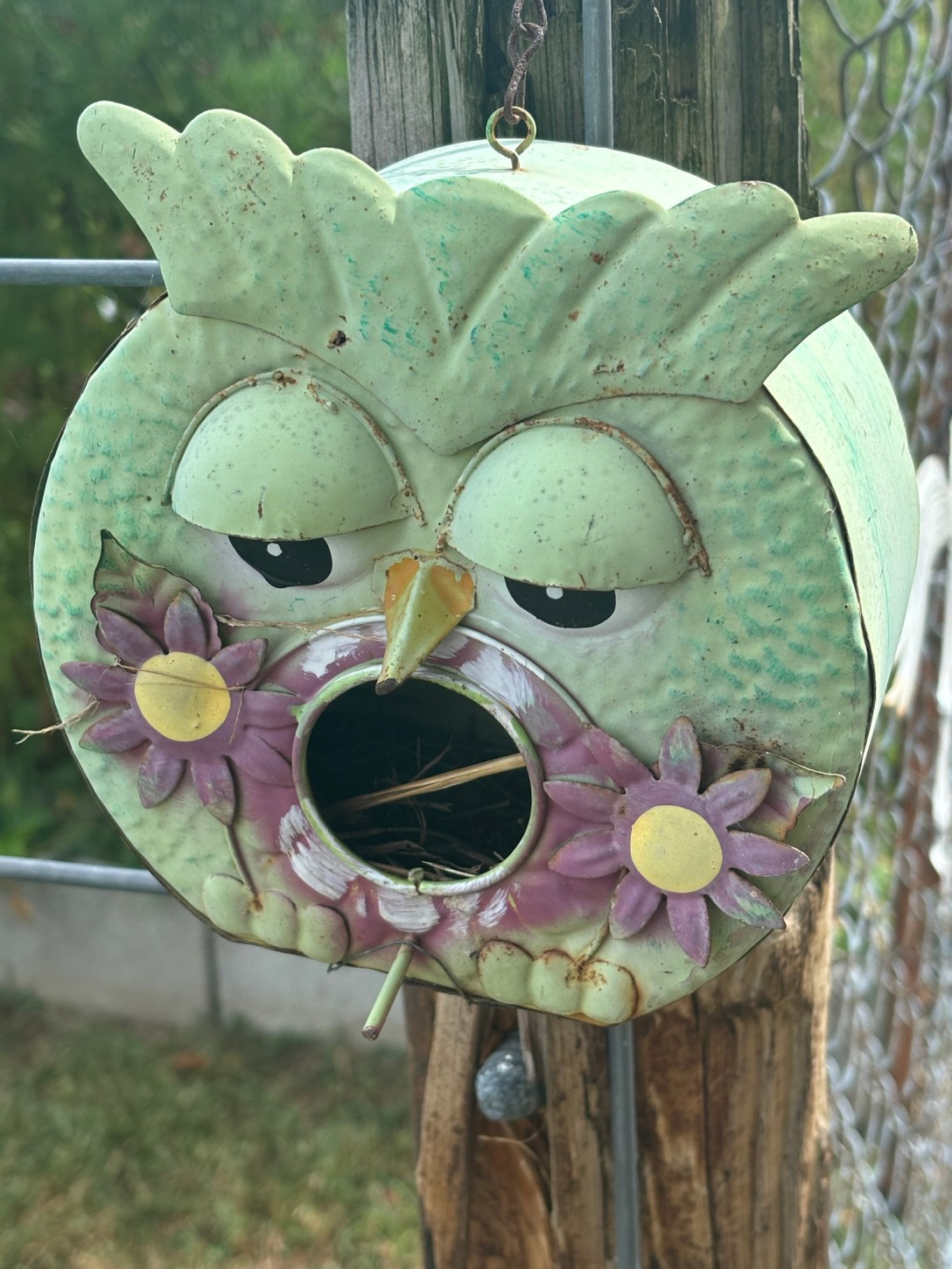
After building the raised beds, we hung cattle panel fencing around the garden with gates on three sides. I was so proud of my design I wanted to decorate it with more than flowers. I attached metal art panels on each of the gates and placed a gazing ball in the middle of my herbs, I hung a small metal birdhouse in the shape of an owl’s head with a small round opening for a mouth. A cruel joke but so very cute. From the top of its head was a dainty little chain and hook so I hooked this over a nail at the corner gatepost so I could see it from the house. I truly thought of this little owl as ornamental and not as a real bird house at all, or else I would have attached it with more vigor. Yet, all summer I have enjoyed watching a pair of Eastern Bluebirds return to this box time and again, climbing in and out of the owl’s mouth with dried grass from our compost or food for their babies. The box is eye level so I can sneak a peak each time I enter the garden.

From my usual spot on the back porch where I sit in the mornings with tea and a journal, or in the gloaming of day’s end, the garden with its little family of bluebirds is in my natural gaze. Behind them, a stand of cosmos. Beside me, a pair of binoculars. From my seat to the garden gate is approximately 50 feet. There is a boxelder tree between us that gives shade to the yard and holds a hammock. The garden gets full morning sun and then the tree protects that little metal birdhouse on the corner from getting too hot in the late afternoon. The first time I saw the birds furnishing their nest, I was a child again, only now I didn’t have to tiptoe or have my dad hold me up to see inside. Before long I was counting eggs, waiting for them to hatch. I watched each day as the couple took turns being in the box or keeping watch on the fence adjacent to it. Once I saw Papa fight off a larger bird that came too close. One evening when Mama and Papa bird must have been on a date or on a run to the grocery, I absentmindedly went to work in the garden without peaking at our babies and they squawked at me with their mouths wide open. If I’d had a worm, freshly chewed, I’d have dropped it in their eager beaks for sure. I felt like their nanny. I anticipated seeing them fledge any day and watched them closely so I could monitor my dogs’ activities and keep the little bundles of joy safe as they shored up their confidence. But the next afternoon, they were gone.

My first thought was not the grave one. Had they fledged during the night? Had I missed the flight while I was at work?  Were my bluebirds so gifted at flying that they didn’t need practice?  They were perfect, after all. Of course, I did land on the idea that something terrible had happened, after I went inside my garden fence to find a smattering of downy feathers peppering my beans.

The parents wasted no time cleaning out the box. Before long they were remodeling with new tufts of straw. I admired their tenacity. Maybe that’s how they grieve. I remember keeping myself busy when experiencing my own empty nest for the first time.  And this gardening surge came along at a time when I needed the earth’s grounding and something to look forward to. Again, I watched their progress, counted their eggs and waited. In the meantime, I googled natural enemies and predators of the eastern bluebird. I found all kinds of ideas for protecting the box from predators.

We live in a healthy ecosystem on our farm by the river. We readily hear and see hawks, owls. We even had an eagle land in our yard once, but he was eating a groundhog. Too big for that little birdhouse. Rabbits are everywhere this year. I imagine that’s keeping the pack of coyotes happy who we mostly hear at night, down by the river. We watch parades of deer and turkey daily. We occasionally smell a skunk who’s perfume wafts in an open window at night and signals the dogs to bark. The peepers in the barn lot pond are deafening at times, especially if it’s going to rain. When I run the soaker hose in the tomatoes, I almost always see a fat bullfrog enjoying the puddles left from a leaky faucet.

I know there is death on the farm, I’ve witnessed it. Coyotes having Thanksgiving Turkey, Bobcats catching rabbits. Mockingbirds stalking and desecrating Luna Moths—which  I find especially egregious. Sometimes the beauty and wonder of nature is so brutal it can break your heart wide open. What I haven’t mentioned is obvious. Google says the snake is #1 on the list of suspects. All of the friends to whom I’ve mentioned my bluebirds say, “Snake.” I say “I don’t think so.” Here’s why: 

  1. That smattering of feathers left behind. Another bird or a racoon would leave feathers behind but maybe a snake would swallow whole?
  2. We mow about an acre all the way around our house and garden. We and/or the dogs are actively in the yard every day; claiming our territory.
  3. The bullfrogs haven’t been snatched yet.
  4. Most Important** and this is the kicker:  I made a pact with their leader, a 6-plus foot black rat snake that I found on my porch one night (that’s another story) just after I moved in. I told her we had 140 acres here and if she would spread the word among her kind that I live in the house and the mowed part of the yard, they could choose their territories over the rest of the farm. The house had been sitting empty a few months. Maybe she had been delegated to check out the new neighbor. I requested she take the barn lot closest to the house to keep the poisonous snakes farther away. A rumor I’d heard but she said nothing, although she did as I’d suggested. She already understood the benefits of that location. I leave them alone. They leave me alone. We’re all happy.

     This has been a good partnership for 12 years now. We sometimes see a random snake in a field, near the barn or on the road but for the most part not close enough to the house to have a reminder talk with them. I’ve only broken my end of the bargain once, last year, when I wanted an old wagon wheel for my herb garden. It was lying in a pile of antique farm equipment I call “the boneyard”. Several wheels and other pieces of antique mule driven farm equipment had been abandoned in the barn lot and overgrown in upstart trees, shrubs and tangles of honeysuckle since my dad traded his mules for a tractor in the early 70’s.  It looks like where the 19th century went to die. I’ve seen my snake friend and her family there many times, on my walks. It’s the perfect location between a barn full of mice and a pond for frogs and drinking water. I knew I’d have to breech my contract with her but I hoped to be in and out without notice. Don’t get me wrong, I’m still scared of snakes. I don’t want to see one, and especially not be close enough to touch it, although I will give a snake a good talking to if I do see it. I’ve always known she was there and I’ve left her alone. I asked my companion to help me recover the easiest wheel I’d spotted and we donned our knee-high boots and work gloves and hiked over. As he pulled and cut and sawed through tough vines, I talked to her and apologized for coming into her home. I hoped she would forgive me. Turns out, she was wrapped around the very wheel we were pulling on. She disappeared quickly into the brush and we both jumped. I continued apologizing, profusely. I looked like a child hopping on one foot and then another while flicking my hands to shoo her away. I wondered then about payback but soon forgot as the spokes of the wagon wheel—lying flat on the ground—made a great dividing frame for my sage, rosemary, thyme and oregano.  

My little bluebirds continued to teach me about persistence, making 2 more nests in a row. Again, I watched, counted, waited. Nothing. No more feathers were found but neither did I witness hatchlings learning to fly. The evidence was mounting but I hoped and decided that without seeing feathers, I’d simply missed their flights while at work. Three times! I was happy and surprised when the birds came back for a fourth time, cleaning, re-stocking, preparing.

            A few days ago, I went out to enjoy the sounds of morning bird frenzy, as usual to collect a few minutes on a cool porch before the heat set in. Our days have been scorchers lately. To my surprise, dangling from the lowest tree limb of my backyard box elder, within ten feet and direct eyeshot of the owl’s open mouth, was the shed skin of a snake, about 3 feet long! Too bad the owl isn’t real. The skin did not belong to my friend the reptilian Queen, who I’d put in charge, because she is much longer than this interloper. One of her not so loyal subjects had snuck into forbidden territory!  

            As I sat, contemplating how to renegotiate peace talks, my partner told me he’d found a baby copperhead enjoying the heat of the compost pile about a month back. Although he’d killed the one he’d found I realized chaos had ensued without my knowledge!

            “A baby?” I asked, “Only one?  Are you sure there weren’t more?” Youngsters can go rogue without yet knowing the unwritten rules of their elders. That’s understandable. But as every old person says, this younger generation has a different set of values.  Leaving the skin in both my view and that of the birdhouse, is a blatant show of disrespect. Also, I was aware this was supposed to be the year of the cicada invasion. Although our region hasn’t been the hardest hit, for months now, Rosie and Willow—otherwise known as dog patrol or affectionately “the girls”—have been staying out late to dig for beetles or cicadas or whatever other little crunchy larvae might be there. I’d read an article about snakes gathering beneath oak trees at night to eat the emerging cicadas and I hoped my girls were abating that possibility.

            I wasn’t sure if Queen Rat Snake was dead, if there had been a coup for leadership, or perhaps she felt I owed her one after my breech into her territory last year. Maybe she decided staying out of my yard in a cicada year was too much for me to ask.

            I went back to writing in my journal, listening to the usual morning rush of cardinals, jays and mockingbirds as they come into the garden for breakfast when I heard a flush of excitement. The bluebirds were back. They had spotted the skin and were sounding all the alarms. Mama was flapping her wings hard, hovering in front of the scaly replica, and if I had to guess cursing him mightily. I hoped she didn’t have a heart attack. I could almost feel how the realization hit her. Grieving her babies while finally getting closure for where they went. This brought Papa. They flew above it, below it, hovered in front of it, flapping their wings and yelling as if to scare it away. It didn’t budge, of course, except for wavering in the wind. The birds called in the cavalry and here came the flickers and mockingbirds, a larger line of defense. They too used their best scare tactics and sounded alarms which pulled in the officers—cardinals and jays. With all the sirens going off, it was the only show to watch, even the dogs were captivated. We were the rubberneckers at the scene of a crime; all traffic stopped. It seemed the teams had forgotten their colors and all acted as one unit to rid the area of this menace. They did all share the same feeders, after all. When the decomposing skin did not respond to their fury, except to sway with the breeze, they finally lost interest and gave it up for dead.

The skin still hangs as a reminder. My hammock chair also hangs in that tree. It’s the only tree I’ve got whose limbs are hammock or swing friendly. I’m not sure how long it will take me to sit there again, unsure what might be overhead. I know the bluebirds have not returned to their box. As with all trauma, it’s gonna take time. Well played Queen. I won’t be taking you for granted again.