Recycling

I wrote this essay many years ago to have a laugh with and about my father. He liked this essay and bragged to his friends that I used him as a muse for my stories. One of his greatest attributes was being able to laugh at himself and tell his own embarrassing stories.

            When Dad had by-pass surgery, Mom’s company was all he wanted. He was like a child, scared to let Mom out of his sight. Having his tender heart manhandled did a real number on his psyche. The rest of us became pegs looking for a hole to fill. How to help him became how to help Mom while she was sitting beside Dad. On one of my visits, I chose to tackle the kitchen.

            I started by washing the dishes which included more cottage cheese containers and peanut butter jars than I care to remember. My parents could never stand to throw away perfectly good containers, with lids! Throughout my childhood, the dreaded empties lined up on the kitchen counter soaking in soapy water. I always hoped they got washed out before it was my turn at the dishes.

I was sure Mom had a real set of dishes, I’d seen them on birthdays and holidays, but they were hidden behind a multitude of Happy Meal cups, margarine tubs and other designs of reusable ingenuity picked up at the local grocery store or fast-food chain. The rest of the country may live in a throw-away society, but not my folks. They don’t throw anything away. With their grandchildren grown, I felt fairly certain Mom and Dad should be able to use the good stuff without breaking it so I took a few liberties with the cleanout. I imagined how happy Mom would be to find I’d made so much new space in her cabinets. Then, I opened the silverware drawer. I expected to see the complete set of table ware that we’d once collected from inside detergent boxes at A & P. I didn’t know I would have to hunt for it beneath the best KFC and Long John Silvers had to offer, separated by color and stuffed into reused plastic bread sacks wedged between the silverware tray and the side of the drawer, which barely closed.

             Being a preacher’s wife meant mom did not have to cook on Sundays. But that didn’t mean she had the day off. After church we visited shut-ins, sick and old, in their homes, in hospitals and nursing homes until supper. ALL of us. Sometimes, if Dad was lucky, a member of his congregation would invite us for a meal after church (saving him money), but, if we were lucky, they wouldn’t. Yes, the home cooked meals were fantastic, but fast food was a rare and festive occasion for us then and Long John Silver’s did not expect the “children to be seen and not heard”.

            Dad never failed to remind us to save our plastic forks, “You never know when you’ll want to go on a picnic.”  His words still resonate. We never questioned it. We lived in a perpetual state of hope for this thing we saw on television which included a red and white plaid table cloth laid out in the middle of some central park like place and a grand basket filled with fried chicken and deviled eggs, our friends frolicking in the background. There may even be a lake involved. The closest we got to a picnic was riding a wagon behind Dad’s tractor down to the riverbank on our farm to watch skiers skim the water on weekends. Mom probably packed sandwiches. Not a bad adventure but we didn’t need plastic forks for that. I wonder if plastic dinnerware is considered a collectible antique after twenty years, like cars? I could be rich!

            Dad was born in 1928, one of thirteen children.

            Recycling wasn’t even a word back then, it was survival. Dad’s skills in saving had been honed to perfection and carried out in our own family. I’m not knocking his frugality; it was a good lesson for me to learn. I still live within my means and re-use everything possible. It’s just that he and Mom kept everything, well past it’s time.

We enjoyed the treasure hunt of yard sales but no treasures were ever found at one of our own. Once my parents were finished with an item, there was no use left in it. Mom wondered why she couldn’t make any money at yard sales like other people did.

            This fork collection though! Mom had gone to the grocery, most likely because she needed out of the house for a breath while I was there with Dad. I felt sure she wouldn’t mind so I started pulling the massive collection from every nook and cranny in several kitchen drawers. Unfortunately, Dad’s reclining chair was positioned with a view to the corner of the kitchen where I began.

“Hey, what do you think you’re doing?” he yelled.

“I’m just cleaning up a bit, Dad.”

“You’re not throwing those away, are you?” I recognized his high-pitched agitation voice from my childhood. I turned to look at him.  

“I’m thinking about it, Dad. We’re all grown now, why would you need dozens and dozens of plasticware you never use?” I asked.

“You never know…” he began.

“When you’ll want to go on a picnic?” I completed his sentence. He knew he was being called out and I knew I’d overstepped my bounds. Here came that high pitched voice again.

“I have no intention for you to come in here while I’m down and go changing everything around. Does your mother know what you’re up to?”

I knew I was treading on fragile ground, here. I didn’t want to cause him more stress.  “Dad, how about this?” I said, “I’ll box them up and label them and you can keep them in storage. But let’s at least clean out these kitchen drawers, can we? I’ll bet Mom would appreciate that. He agreed, albeit reluctantly. I found a shoe box (of course I found a shoe box, they never got thrown away either) and started stuffing all the white forks and knives and spoons into it, realizing I was going to need a second box for the black set.

            A couple of months passed with no mention of the ‘cleaning incident’.  It was late August and time for our family reunion, which Dad always organized. With his recent open heart surgery, they were going to need some help. Mom phoned to ask what I would bring and let it slip that Dad had volunteered to supply utensils. We both laughed. I should have been glad he’d decided to finally use the things. Or, re-use them as the case may be. I know in my head that plastic can be washed, but somehow the idea of these used plastic forks just bothered me. Who knows, the person I might be eating after could be me—some twenty-five years earlier. It just didn’t seem right.

            Dad, one of thirteen children, gifted me with forty-eight first cousins. Reunion Day arrived and so did our relatives, like a gaggle of geese migrating south. Some in fancy cars as if to say we too should have followed them north for better jobs and better lives. I had no intention of telling them about the forks. I actually thought it was a little bit funny. I came, of course, equipped with my own.

            Standing in line for food I noticed my cousin Bobby, a local, with a stainless-steel fork sticking out of his back pocket. His mother and my Dad were siblings. I slid in the food line behind him. “I see that,” I whispered, tapping on the fork. 

            He pulled me aside as if we were about to become traitors to our country.  “Listen,” he said, “my mom saves her used plastic forks and brings them to these reunions. I’d be careful if I were you, which one you choose.”

            “It’s worse than you think,” I said, laughing, “so does my dad.”  I pulled out my fork to show him and we both broke out laughing. He raised an eyebrow and we looked around the room at all those unsuspecting cousins.

            “You mean all the plastic ware on that table have been used already?” he said.

            “Yep. Should we tell anybody?”

            “No way. It’s too late anyway.” Then, we saw Kim, another local, her mother another sister to the two culprits. The three of us had become pretty close as cousins go. We hated to leave her out so we approached as if we had unearthed a murderous family skeleton.

            “Kim,” I began, “Bobby and I want to tell you a secret.”

            “What’s that?” she grinned.

            “My dad and his mom save all their used plastic forks and bring them to this reunion. We brought our own!” We each pulled our stainless-steel forks out of our pockets.

            “Why do you think I’m carrying my own soda can?” Kim said, “My mom brings the cups.”
Rollin’, 2008

(This essay was written in 2008 under the title, “Balls”. At the time, my life was taking a major turn. I was still married, although barely.)

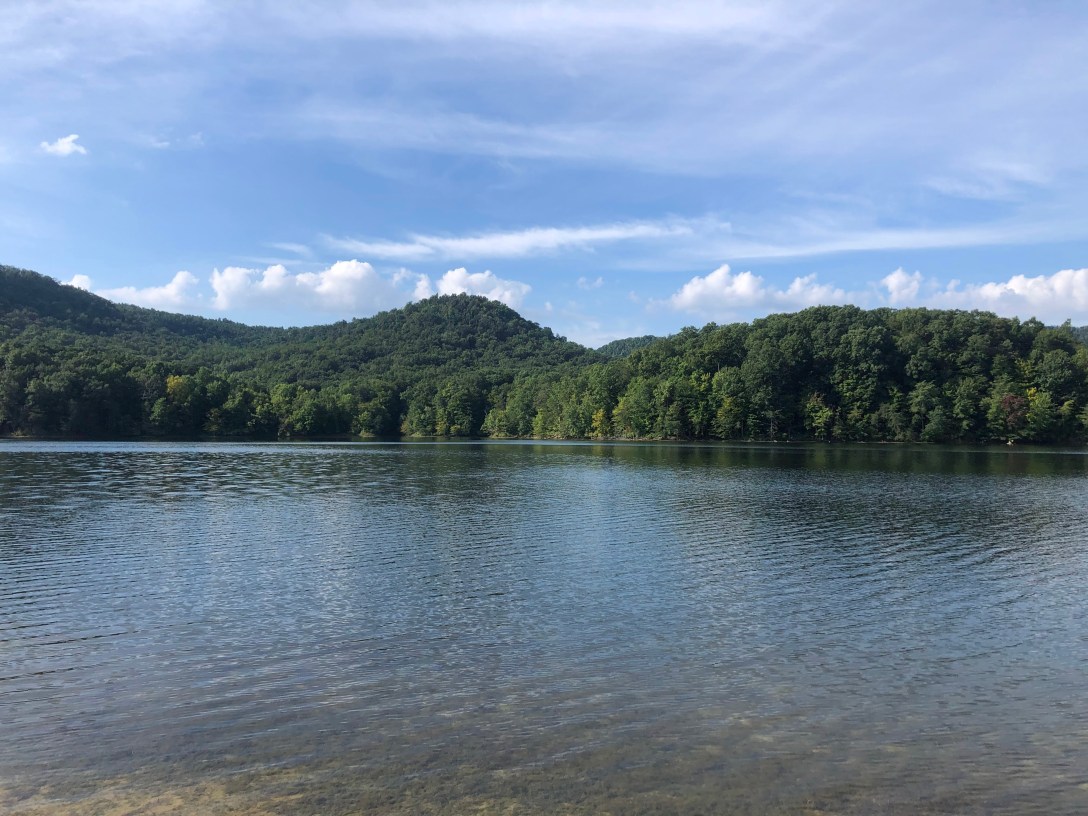
Thanks to the Kentucky River Sweep, an initiative where volunteers in a parade of boats clean the river, our water and its banks contain less trash than they have in years.  My (now ex-) husband and I both grew up on the Kentucky River; him, a water dog and me, a bank dweller.  My parents’ farm borders the river and though they tried their best to keep me out of it, I spent hours on the bank fishing and watching boats go by. His parents owned boat after boat, even living on one for a while. Between the two of us, we have seen almost everything floating in that pool from bleach bottles to cow carcasses and shot most of it with our Daisy Red Ryders. Until a concerted effort was made to clean the unnatural floating debris left by careless polluters, one particular phenomenon escaped us both. That is, the great number of balls that end up there; basketballs, soccer balls, volley balls, kickballs. Easily a natural migration of gravity, or is it something more.  

            On a recent trip between locks and dams, a twenty-mile journey in our 1969 Lonestar Runabout, we spotted at least six different balls. There were virtually no other foreign objects.  So, we figured, with people being more careful, the balls must be getting there on their own. If it is round and filled with air, it eventually makes its way to the river. We were surprised we’d never noticed before. I also wonder if maybe this is new, a result of our throw away mentality.  When I was a kid, a ball, even deflated, held promise of future play. We never threw anything away, using it far beyond its natural life and then holding on to it just in case. What does it say about us today that we allow our kids to so easily discard these loyal playmates, leaving them to fend for themselves.

I love the river. This natural waterway snakes a path in and out of hollows and past people’s homes, gathering knowledge and strength from its mountain origins, never making excuses for humble beginnings. Every drop of water as important as the next, it eventually spills its wisdom into the great fountain that is its destiny. Along the way, it watches the life and death of farms and children as well as corn, cows and marijuana. Towns and Cities gather at its banks as the gentle lapping of water whispers the secrets of its people. Trees line the narrow banks of the Kentucky like arms welcoming a child come home and together with the sun provide a strobe-like prism across our faces transporting us from our daily worries. And, this little piece of heaven is as close as our next breath or our next drink of water. No wonder the balls want to go there. They are drawn, like us, to a better place. Who could blame them?

I thought about the lives these balls had witnessed and the children they had entertained.  Perhaps, even while being loved, they were taken for granted or sometimes abused. No matter how good the intention, a Chuck Taylor to the gut is never easy to take. I have to say, as a mother in the hollows of an empty nest, I know how they feel. Like a helium balloon cut loose after the party, they are no longer needed. They have entered a new phase of their existence. The purpose they served for so many years now finished, they must re-define themselves, find meaning in their last days. I have seen them, left in the yard, un-noticed, deflated, until one day, I imagine they hear the call of a faint song on a distant breeze, “Brothers and Sisters, come on down, come to the river to pray.”  A spa for old balls to soak, carefree on endless days. With no pressure to hold breath against hard concrete or bony fists, the tired, half inflated sphere allows the warmth of the sun to expand its possibilities, breathe in new life.  It waits for the earth to move, a wind or maybe a flood to begin this journey of patience and gravity.  Like aging, only a slow-motion camera could recognize their gradual yet deliberate migration southward.The lesson is not lost on me. We all need patience and perseverance to get where we’re going.

Driving across the river on a one lane bridge, following the railroad track up Miller’s Creek Road, I saw two more balls well on their way. One, a basketball, had made it all the way to the road but landed in the ditch. I wondered how long it would take before a rain would come heavy enough to get it out of that predicament. I pictured an over-loaded logging truck unable to brake on a wet road just as the ball started across. I almost stopped like I do when I see a turtle in the road. I thought tossing the ball over the hill would take months off its journey and ensure a safe passage, but then I saw a kickball down by the railroad tracks waiting for the next coal train to rattle the ground and I realized the path is never safe. There are dangers everywhere. With only six balls in a twenty-mile span, it is clear only the strongest survive. It’s the natural order of things and just because I noticed it, doesn’t mean I can change the outcome. Maybe, no matter how much help they receive, the ultimate responsibility is theirs to stay focused on the goal and take their chances with fate.  It takes guts…or balls to keep rolling along knowing they may not make it. Maybe even inanimate objects know it’s the journey that matters most. Maybe the obstacles they overcome make the destination even greater and the memories, stories they can tell the next generation. Maybe this story has little to do with abandoned soccer balls.

With the passing of my father-in-law, I helped sort through his life’s remains. The things left behind do tell stories, some are hard to listen to while others bring a chuckle. Packrats that we are, children of parents who lived through the first depression, parents of children who are about to experience one for the first time, the need to scrimp and save may come back into vogue. We tried to find a home for any good item we didn’t want, but even with conscious minds, there are some things that never should’ve been saved in the first place.  When the garbage men came to pick up some thirty-odd contractor bags full of trash there was still a basketball on the shelf in the garage, older than our grown children, breathless and bounce-less. I couldn’t throw it away. One of the men said, “What you gonna do with that basketball?”

“It’s yours if you want it,” I said, happy to find a willful home.

“I collect old balls. Pick’em up every chance I get. Sometimes we see them in the ditch,” the garbage man said. “I always stop.” 

 “What do you do with them?” I felt hopeful for one last ditch effort to give these balls another chance.

“We have an awful problem with dogs chasing the truck, but those balls take care of it,” he said.

“What do you mean? You throw it at them?”

“Naw, I’ll show you,” he said as he continued to load our discards. I hadn’t noticed when he’d wedged the basketball between the tandem tires on the back right side and hollered at his driver to pull up. “Hold your ears,” he said. It blew like a stick of dynamite. He straightened his back proud and waited for our praise of his genius. “Stops dogs in their tracks.”

 Clearly, I’ve given this way too much thought but I caught myself feeling sorry for the ball. It hadn’t played for years, but now it would never even make it to the river. Then, I remembered something my son told me while we were visiting his grandmother in the nursing home.

            “You don’t ever have to worry about going to a place like this.  I’m not gonna let it happen,” he said.

            “Are you going to take care of me?” I asked, surprised at his concern.

            “Naw,” he said. When it gets to that point, I’ll just shoot you in the head.” 

“Thanks son, that makes me feel so much better.”

All kidding aside, I know from experience there are a lot worse things than death. So, I’ll continue to notice the balls in odd places and wish them well and think about them as I wander along and hope that wherever my journey ends, the stories of how I got there will be good and the view as beautiful as an autumn day on the Kentucky River.